
Why Agile Menus Suit F&B Entrepreneurs: Protect Margins
- Abhi Bose
- 2 days ago
- 8 min read


Agile digital menus are the single most effective tool F&B entrepreneurs have right now for protecting margins and growing revenue simultaneously. Operators who switch from static print to a living digital menu often see a significant lift in average order value within the first few months, driven by visual upsells, smart combos, and dayparted pricing. The mechanism is straightforward: when you can change a price, hide a low-margin item, or launch a limited-time offer (LTO) in minutes rather than weeks, you stop bleeding margin every time food costs spike.
To capture that lift fast, run a pilot lasting around three months. Integrate your POS from day one, activate dayparting for at least two distinct periods (lunch and dinner), and set a hard sunset date for every LTO before it launches.
AOV lift: 8–18% within 90 days versus printed menus
Margin defense: real-time price edits and item-visibility controls respond to ingredient cost swings before they hit your P&L
Speed advantage: digital updates take minutes; reprints take days and cost money
Table of Contents
Why agile menus give F&B entrepreneurs a real business edge
The business case for flexible menus for restaurants goes well beyond convenience. Agile menus touch four revenue levers at once.
Revenue and AOV. Visual upsells, combo suggestions, and dayparted digital signage push average order value upward by surfacing the right items at the right moment. The AOV lift observed is sustained over time; operators who treat the menu as living sales tooling and run monthly refinement cycles sustain those gains over time.
Margin protection. Inflation is the enemy of a fixed menu. Menu agility lets you make small, frequent price corrections on high-volume items, which creates far less guest friction than a large quarterly hike. You can also instantly hide a dish when its key ingredient spikes, protecting contribution margin without a reprint.
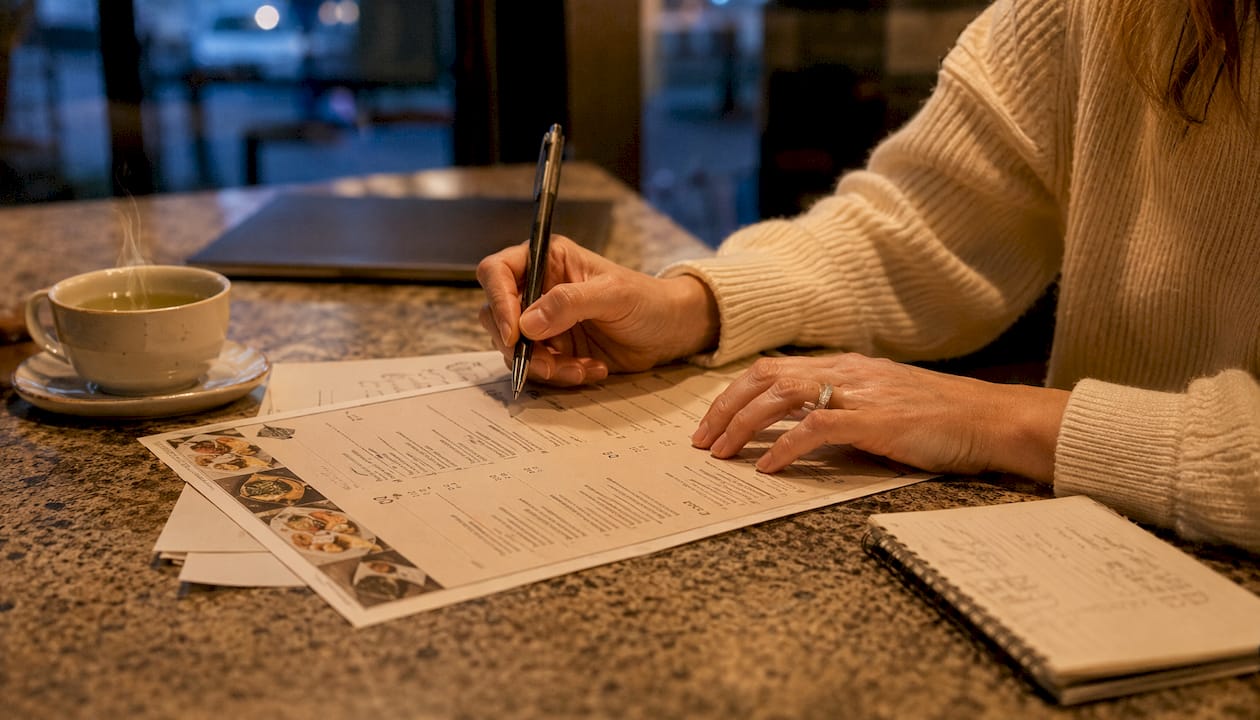
Operational savings. Eliminating print cycles removes both the direct cost and the lag. Fewer order errors follow naturally when guests select from a current, accurate menu. Staff spend less time fielding “is that still available?” questions.
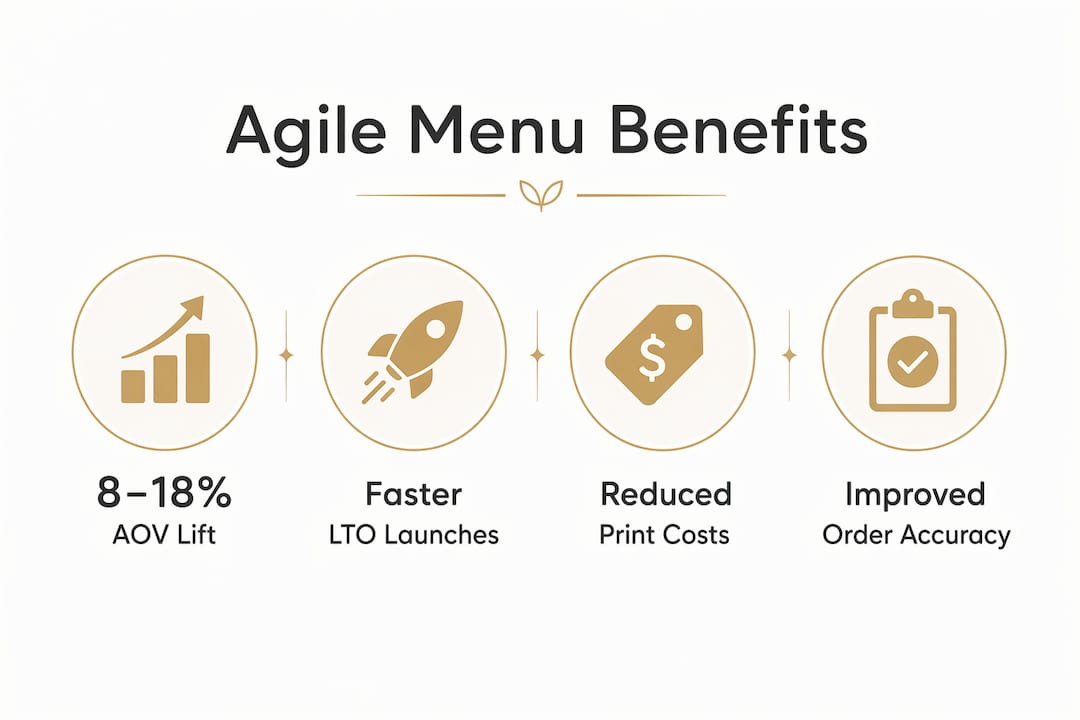
Marketing velocity. LTOs that once took weeks to roll out now launch in an afternoon. CRM-driven promos and loyalty integrations turn one-time visitors into regulars, and guest engagement data tells you which offers actually moved the needle.
What features actually create menu agility?
“Agile” is only as real as the platform capabilities underneath it. Here is what to require.
Real-time price and content updates: schedule daypart switches and LTO windows in advance so the menu changes automatically, no manual intervention needed.
POS integration with two-way inventory signals: when an item sells out, it auto-hides from the guest-facing menu. This prevents the frustration of ordering something unavailable and protects kitchen throughput.
Modular CMS with rich media: progressive disclosure patterns (hero rail, categorized sections, modifier drawers) outperform crowded screens and surface which items guests click but don’t order, pointing to photography or description fixes rather than pricing changes.
Analytics and A/B testing: conversion tracking, click-to-order funnels, and item-level dashboards tell you what is working before you commit to a full menu cycle.
Integration breadth: CRM, loyalty programs, payment gateways, reservation systems, and delivery platforms must connect cleanly via API. A menu that cannot talk to your other systems is an island.
A well-designed restaurant menu also uses layout and imagery deliberately, because the visual hierarchy shapes what guests order before they even read a description.
How to implement an agile menu workflow in 90 days
Adopting an agile approach in the food industry is as much a cultural shift as a technical one. Cross-departmental collaboration between kitchen, operations, and marketing is the foundation.
Assign ownership before launch. Designate who approves each type of change: kitchen signs off on item additions, ops controls pricing edits, marketing owns LTO creative. Without clear roles, changes stall or conflict.
Define your pilot scope. Choose two to three dayparts and three to five LTO candidates. Set KPIs upfront: AOV, attach rate for add-ons, and item conversion rate.
Integrate POS on day one. Two-way inventory sync is non-negotiable. A distributed menu update system ensures every location or terminal reflects the same current state.
Run a weekly content test. Swap one hero image or item description per week. Track the before/after conversion rate over a minimum of 200 orders before drawing conclusions.
Set sunset rules for every LTO. Define a minimum daily sales velocity threshold before launch. If an LTO fails to hit that threshold within two weeks, retire it. This prevents menu bloat and kitchen overload.
Hold a monthly menu engineering review. Use the Stars/Plowhorses/Puzzles/Dogs framework to decide which items to promote, reprice, reposition, or remove.
Pro Tip: Set your LTO sunset date in the platform scheduler at the same time you launch the offer. That way, the item disappears automatically even if your team forgets to pull it.
The pilot target is to achieve an 8–18% uplift in average order value within approximately three months. If you hit the lower end of that range by week eight, double down on the daypart driving it. If you are flat by week six, audit your POS integration and hero imagery first.
What does agile menu pricing actually cost, and what is the ROI?
Most digital menu platforms follow a subscription-plus-transaction model. Understanding the cost shape helps you estimate payback quickly.
Cost element | Typical shape |
Monthly subscription | Per-location or tiered by feature set |
Setup / integration fee | One-time; varies by POS complexity |
Transaction / voucher fee | Percentage of digital gift voucher sales |
Creative refresh | Included in Menu-as-a-Service tiers |
The Menu-as-a-Service model reframes menu innovation as a variable operating expense rather than a capital project. Instead of a large annual reprint budget, you pay a predictable monthly fee and get continuous creative refreshes, LTO pipelines, and analytics included.
ROI example: A café averaging $18 AOV across 400 covers per day generates $7,200 in daily revenue. An 8% AOV lift adds $576 per day, or roughly $17,280 per month. A mid-tier SaaS subscription typically costs a fraction of that monthly gain, putting payback well inside the first 30 days of the pilot.
Pro Tip: Factor in print cost elimination when building your ROI case. A single menu reprint run for a 50-table restaurant can cost $300–$800; agile menus make that line item disappear.
Enterprise or multi-location operators should evaluate managed-service tiers where the vendor handles content production, scheduling, and analytics reporting, reducing internal overhead significantly.
How do you know if your agile menu strategy is working?
Measurement is what separates a genuine agile menu strategy from a digital menu that just looks modern. Track these KPIs on the cadences below.
Daily: out-of-stock frequency, menu update completion rate, and kitchen throughput by daypart
Weekly: AOV by daypart, attach rate for combos and add-ons, and LTO velocity (units sold per day)
Monthly: item conversion rate, contribution margin per item, and waste reduction tied to better demand forecasting
Quarterly: full menu engineering cycle using the Stars/Plowhorses/Puzzles/Dogs matrix; strategic re-engineering of the menu architecture
When you see a conversion uplift without a corresponding traffic increase, the menu itself is doing the work. That is the signal to expand the winning pattern to more dayparts or locations. When traffic rises but conversion stays flat, the problem is usually photography or description quality, not pricing.
Monthly refinement cycles of layout, copy, and imagery are what sustain AOV gains over time. A one-time rollout without iteration captures only a fraction of the available lift.
Common pitfalls when you go agile (and how to avoid them)
The benefits of agile menus are real, but so are the implementation traps.
Menu bloat: uncontrolled LTOs accumulate and overwhelm both guests and kitchen staff. Fix: enforce sunset rules and a maximum active-LTO count before launch.
Kitchen overload: too many new items added too fast increases prep complexity and slows throughput. Fix: limit new additions to items that share existing prep steps with core dishes.
Data illiteracy: staff who don’t understand the dashboards can’t act on them. Fix: share one simple weekly report with three metrics, and hold a 15-minute review every Monday.
Inconsistent brand presentation across locations: local managers making ad-hoc changes break visual standards. Fix: use central templates with defined local-override rules so creativity stays within guardrails.
Pro Tip: Roll out agile menu changes in small batches, not all at once. Changing three items per week gives your team time to learn the system and gives your data time to stabilize before the next test.
Digitizing restaurant operations successfully depends on training cadence as much as technology. Short, frequent training sessions beat a single all-day onboarding.
Key Takeaways
Agile digital menus protect margins and lift AOV by 8–18% within 90 days when paired with POS integration, clear governance, and a disciplined monthly testing cadence.
Point | Details |
AOV lift benchmark | Expect an 8–18% increase in average order value within the first 90 days of your pilot, based on industry benchmarks. |
Governance before launch | Assign change-approval roles and LTO sunset rules before going live. |
Weekly KPI rhythm | Track AOV, attach rate, and LTO velocity weekly; run full menu engineering quarterly. |
Menu-as-a-Service model | Treat menu innovation as a variable monthly expense, not a capital reprint project. |
Mydigimenu as your platform | Mydigimenu supports real-time updates, POS integration, CRM, loyalty, and analytics — a direct fit for the agile menu workflow described here. |
The part most operators get wrong about going agile
The conventional wisdom says the hard part of adopting an agile approach in the food industry is the technology. After watching operators across multiple concepts work through this transition, the real friction is almost always governance, not software.
Platforms that enable real-time updates are widely available. What is rare is a team that has decided, in writing, who can change what and when. Without that clarity, the menu becomes a free-for-all: marketing adds LTOs the kitchen wasn’t briefed on, prices get edited without ops approval, and the data becomes unreadable because too many variables changed at once.
The operators who capture the full 8–18% AOV lift are the ones who treat the menu like a product, with an owner, a release cadence, and a rollback plan. The technology is the easy part. The discipline is the differentiator.
How Mydigimenu helps you build an agile menu operation
Mydigimenu gives F&B entrepreneurs the exact feature set this guide describes, without the complexity of stitching together multiple tools. Real-time price and content updates, QR menus for instant contactless access, scheduled LTO windows, POS and delivery platform integrations, CRM, loyalty programs, and multi-language/currency support are all built into one platform.
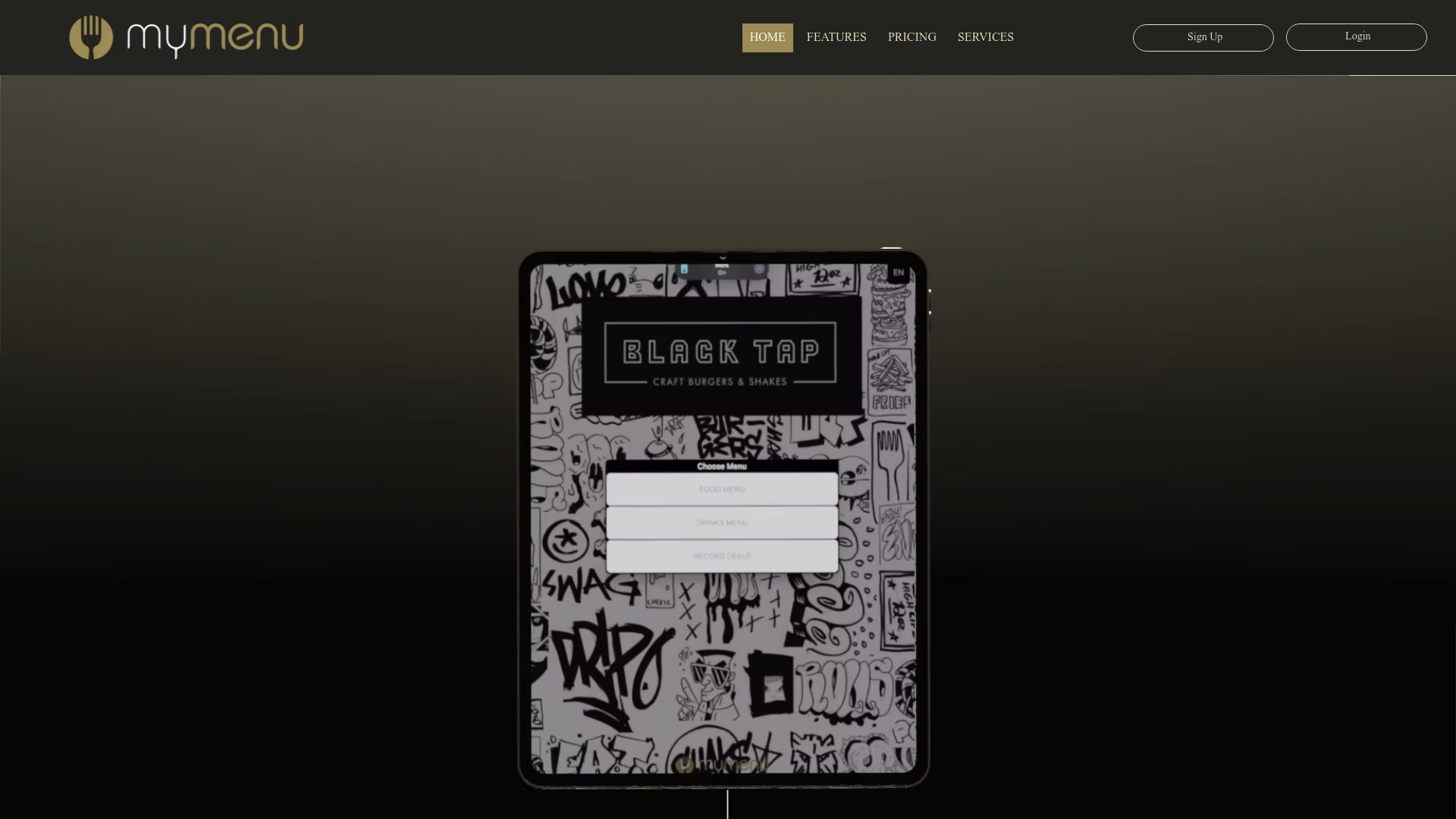
The Menu-as-a-Service approach means your team gets continuous creative support and analytics without hiring a dedicated menu manager. Mydigimenu’s tablet and iPad menu solution is particularly well-suited for table-service operators who want rich media upsells and pay-at-table in a single interface. For operators ready to run the 90-day pilot described here, explore current USD pricing and request a demo to see how fast a pilot can go live.
Useful sources and further reading
8–18% AOV lift: digital menus for restaurants — The primary industry data point anchoring the AOV benchmark used throughout this guide.
Menu agility and inflation defense — Practical framing of why frequent small price adjustments outperform large infrequent hikes.
Agile menu development defined — Covers the cross-departmental collaboration and data literacy requirements for a successful rollout.
Menu-as-a-Service model explained — How variable-cost menu innovation works and why it suits growing operators.
Interactive menu guide and progressive disclosure — UX patterns, monthly refinement cycles, and conversion data for digital menus.
LTO exit strategies and velocity thresholds — How to define sunset rules and prevent menu bloat in multi-unit operations.
Menu engineering framework — The Stars/Plowhorses/Puzzles/Dogs matrix and recommended review cadences.
Mydigimenu blog — Product-specific how-tos, implementation checklists, and case studies for operators deploying digital menus across single and multi-location concepts.
Recommended
Comments