
Nutritional Labeling Explained: Your 2026 Reading Guide


TL;DR:
Nutritional labeling is the federally mandated display of essential nutrient information on packaged foods to help consumers make informed choices. It includes standardized data such as calories, fats, sodium, and key micronutrients, with updates reflecting evolving scientific understanding. Reading the Percent Daily Value and serving size enables better dietary decisions and encourages food reformulation for healthier options.
Nutritional labeling is defined as the federally mandated display of essential nutrient information on most packaged foods, designed to help consumers make informed dietary choices. The Nutrition Labeling and Education Act (NLEA), enacted in 1994, established the Nutrition Facts label as the U.S. standard, requiring manufacturers to disclose calories, fats, cholesterol, sodium, carbohydrates, fiber, sugars, protein, and key micronutrients. The FDA enforces these requirements and updates them as nutritional science evolves. Understanding what is nutritional labeling gives you the power to compare products, manage chronic conditions, and build a diet that actually works for your body.
What is nutritional labeling and what does a Nutrition Facts label include?
The Nutrition Facts label is a standardized panel that appears on virtually every packaged food sold in the United States. Its structure follows FDA regulations, so every label you pick up presents the same categories in the same order. That consistency is the point. It lets you compare a box of cereal to a bag of granola without doing mental gymnastics.

Every label starts with serving size and servings per container. These two figures anchor everything else on the panel. Serving sizes reflect typical consumption amounts, not dietary recommendations, so a bag of chips listed as “3 servings” does not mean three people should share it. It means the manufacturer calculated nutrients based on that portion.
The core nutrients listed on every compliant label include:
Calories: Total energy per serving
Total fat: Broken down into saturated fat and trans fat
Cholesterol: Measured in milligrams
Sodium: A key figure for heart health management
Total carbohydrates: Includes dietary fiber, total sugars, and added sugars
Protein: Measured in grams
Vitamin D and calcium: Critical for bone health
Iron: Supports red blood cell production
Potassium: Linked to blood pressure regulation
The 2026 label revision added vitamin D and potassium as required nutrients, reflecting population-wide deficiencies identified by public health research. That addition matters because it shifts the label from a simple calorie counter into a genuine nutritional snapshot.
Pro Tip: Always check the “servings per container” line before anything else. A product with 150 calories per serving sounds reasonable until you notice the container holds four servings.
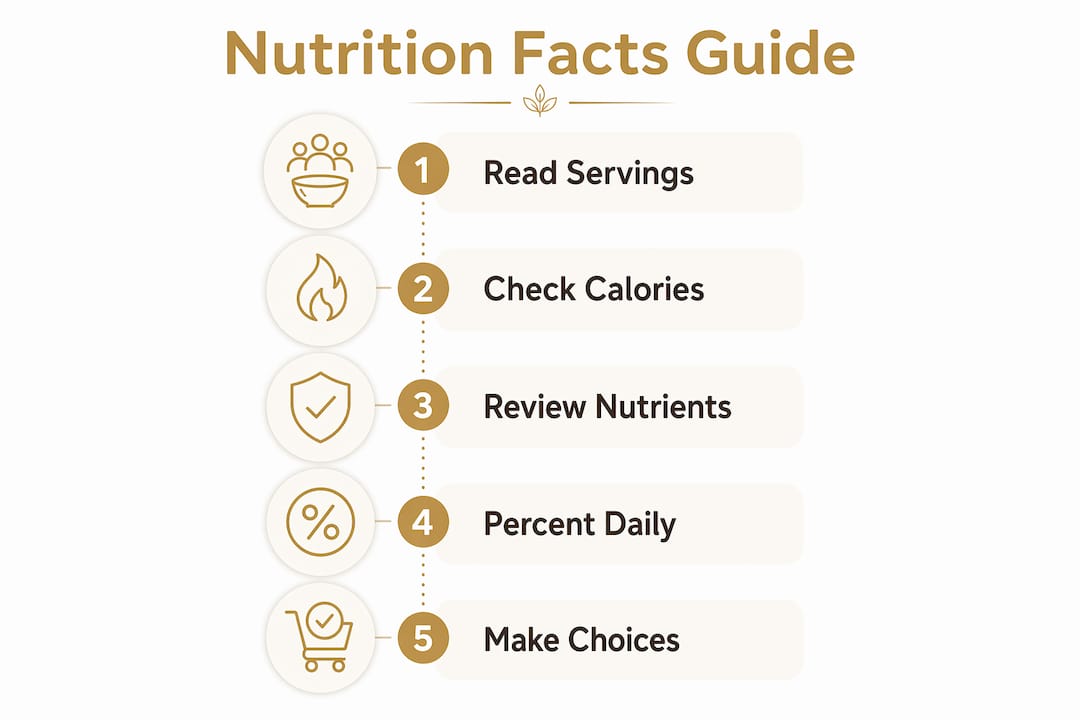
How do you interpret the Percent Daily Value on food labels?
The Percent Daily Value (%DV) is the single most useful tool on the Nutrition Facts label, and most people misread it. The %DV tells you how much one serving of a food contributes to your total daily intake of a nutrient, based on a 2,000-calorie reference diet.
The FDA provides a clear benchmark: 5% or less is low, and 20% or more is high for any given nutrient. Use that rule to sort nutrients into two categories.
Nutrients to limit:
Saturated fat: High intake raises LDL cholesterol and increases cardiovascular risk.
Sodium: Excess sodium contributes to high blood pressure over time.
Added sugars: Linked to weight gain, insulin resistance, and dental decay.
Nutrients to get more of:
Dietary fiber: Supports gut health and helps regulate blood sugar.
Vitamin D: Most Americans fall short, raising risk of bone loss and immune dysfunction.
Calcium: Required for bone density throughout life.
Iron: Deficiency causes fatigue and impaired cognitive function.
Potassium: Counteracts the blood pressure effects of sodium.
The %DV becomes especially useful when you eat more than one serving. If a bag of popcorn lists 15% DV for sodium per serving and you eat two servings, you have consumed 30% of your daily sodium from that one snack. That math adds up fast across a full day of eating.
Pro Tip: Your actual daily needs may differ from the 2,000-calorie reference diet. Children, older adults, and people with specific health conditions should use %DV as a directional guide, not a precise prescription.
How has nutritional labeling changed food formulation and consumer behavior?
Mandatory labeling does more than inform shoppers. It changes what food manufacturers put in their products. The clearest example is trans fat. Trans fat labeling became mandatory in 2006, and the food supply responded quickly. Products reformulated their recipes, and the number of items labeled as 0 grams of trans fat grew substantially by 2010. Visibility on the label created a market incentive to remove a harmful ingredient.
The same dynamic plays out with sodium and added sugars. When consumers can see a number, they can react to it. Manufacturers who want to compete on health credentials have a direct reason to reduce those figures.
“Labels help solve information asymmetry between consumers and food suppliers, but can be misleading if shoppers focus on single-nutrient marketing rather than overall nutrition.” This insight from the USDA Economic Research Service captures the core tension in label reading. A product can be technically “low fat” while being high in added sugars and sodium.
The FDA regulates nutrient content claims with specific numeric thresholds. “Low sodium” means less than 140 milligrams per serving. “Reduced” means at least 25% less than the original product. These are legal definitions, not marketing opinions. Knowing them protects you from being misled by front-of-pack language.
The practical lesson is to read both the Nutrition Facts panel and the ingredient list. The panel shows quantities. The ingredient list shows what is actually in the food, ranked by weight from most to least. A product with “whole grain” on the front but refined flour listed first in the ingredients is telling you something important.
How accurate are nutrition labels and how are values determined?
Nutrition labels are reliable for everyday diet management. They are not clinical measurements. Manufacturers build their labels using one of two methods: reference databases such as the USDA National Nutrient Database, or direct laboratory chemical analysis of the product.
NIST Standard Reference Materials (SRMs) serve as the gold standard for verifying measurement accuracy. These are certified food samples with known nutrient concentrations that labs use to calibrate their testing equipment. Without SRMs, there would be no consistent way to confirm that one lab’s results match another’s.
Nutrient category | Typical accuracy range |
Macronutrients (fat, carbs, protein) | Within 2%–5% of labeled value |
Minerals (calcium, iron, potassium) | Within 2%–5% of labeled value |
Vitamins (D, C, B vitamins) | Within 5%–15% of labeled value |
Vitamins show wider variation because they degrade during storage, cooking, and processing. A vitamin C value measured at the time of production may differ from what you consume six months later. That is not a labeling failure. It is a chemistry reality.
Individualized lab testing of every production batch is not standard practice. Most manufacturers test a representative sample and apply those values across the product line. This approach works well for consistent, shelf-stable products. It introduces more variability for fresh or minimally processed foods.
Pro Tip: If you manage a medical condition that requires precise nutrient tracking, such as kidney disease or phenylketonuria, consult a registered dietitian. Nutrition labels give you a solid estimate, but clinical nutrition management requires more precision than a label can provide.
Key Takeaways
Nutritional labeling is the most direct tool consumers have for comparing food products, managing nutrient intake, and holding manufacturers accountable for what goes into packaged foods.
Point | Details |
Serving size is the anchor | All label values are per serving, so always check servings per container first. |
%DV guides nutrient decisions | 5% or less is low; 20% or more is high for any nutrient on the label. |
Labeling drives reformulation | Mandatory trans fat disclosure led manufacturers to remove it from products by 2010. |
Labels are accurate but not clinical | NIST SRMs confirm macronutrient accuracy within 2%–5%; vitamins may vary by up to 15%. |
Front-of-pack claims need context | “Low fat” and “reduced” are legal terms with specific thresholds, not general health endorsements. |
Why I think most people read food labels backward
Most people glance at the front of a package, spot a claim like “multigrain” or “no artificial flavors,” and feel satisfied. They never open the Nutrition Facts panel. I have watched this happen repeatedly, and it is the single biggest mistake in everyday food shopping.
The front of a package is marketing. The Nutrition Facts panel is regulated disclosure. Those are two very different things. Dietitians consistently recommend checking serving size first, because every number on the label is meaningless without that reference point. A “light” yogurt with 80 calories per serving sounds excellent until you realize the container holds two servings and you always eat the whole thing.
The second mistake I see is fixating on a single nutrient. Someone trying to lose weight zeros in on fat grams and ignores added sugars. Someone watching their heart health cuts sodium but overlooks saturated fat. Labels are designed to be read as a whole picture, not mined for one favorable number.
My honest advice: spend 30 seconds on the full panel before any new product goes into your cart. Check serving size, calories, sodium, added sugars, and fiber. Those five data points tell you most of what you need to know. Over time, reading food labels this way becomes automatic, and your purchasing decisions get sharper without requiring a nutrition degree.
— Abhi
How Mydigimenu brings nutritional transparency to restaurant menus
Nutritional labeling does not stop at the grocery store. Diners increasingly expect the same transparency at restaurants, cafes, and hotels. Mydigimenu makes that possible for food businesses of any size.

The platform lets restaurant and hospitality operators display detailed nutritional info on menus directly within their digital QR menus and tablet menus, giving guests the calorie counts, allergen flags, and macronutrient data they need to make confident choices. No printed inserts, no outdated paper menus. Just accurate, up-to-date information that builds guest trust and supports regulatory compliance. Explore Mydigimenu’s digital menu platform to see how nutritional transparency can become a natural part of your dining experience.
FAQ
What is nutritional labeling in simple terms?
Nutritional labeling is the standardized display of nutrient information on packaged food, required by the FDA under the NLEA since 1994. It tells you what is in a food and how much of each nutrient one serving contains.
What nutrients must appear on every Nutrition Facts label?
Every U.S. label must list calories, total fat, saturated fat, trans fat, cholesterol, sodium, total carbohydrates, dietary fiber, total sugars, added sugars, protein, vitamin D, calcium, iron, and potassium.
How do I use %DV to make healthier choices?
Use the 5% and 20% rule: 5% DV or less means a nutrient is low in that food, and 20% DV or more means it is high. Aim for low %DV on saturated fat, sodium, and added sugars, and high %DV on fiber, vitamin D, and potassium.
Are nutrition labels always accurate?
Labels are accurate within 2%–5% for macronutrients and minerals, verified using NIST Standard Reference Materials. Vitamins may vary by up to 15% due to degradation during storage and processing, but labels remain reliable for general diet management.
What does “reduced” mean on a food label?
“Reduced” is an FDA-regulated claim meaning the product contains at least 25% less of a specific nutrient compared to the original version of that product. It does not mean the product is low in that nutrient overall.
Recommended
Comments