
Nutritional Information Display Guide for Restaurants


TL;DR:
Proper nutritional display ensures compliance and builds customer trust by providing clear, accurate information.
US and EU regulations differ in nutrient listings, placement, and formatting, requiring careful adherence.
Nutritional information display is the process of accurately calculating, formatting, and presenting key nutrient data on food menus to comply with legal standards and inform customers. Two major regulatory frameworks govern this practice: US FDA 21 CFR Part 101 and EU Regulation 1169/2011. Restaurant and food service managers who understand both frameworks avoid costly audit failures and build genuine customer trust. This guide covers the core requirements, calculation methods, presentation best practices, and common pitfalls that trip up even experienced operators. Getting this right is not just about compliance. It is about giving guests the clarity they need to make confident dining choices.
What are the core regulatory requirements for nutritional information display?
US and EU regulations share the same goal but take different approaches. Knowing which rules apply to your operation is the first step in any step-by-step nutritional info display process.
US FDA requirements under 21 CFR Part 101

The FDA requires Nutrition Facts panels to list a specific set of nutrients in a fixed order. US regulations mandate calories, total fat, saturated fat, trans fat, cholesterol, sodium, total carbohydrate, dietary fiber, total sugars, added sugars, protein, vitamin D, calcium, iron, and potassium. That list is not optional. Omitting any one of these triggers a compliance failure.
Placement is equally regulated. Nutrition Facts panels must appear on the Principal Display Panel or the adjacent Information Panel, with specific formatting and ordering rules under 21 CFR Part 101.2. This means you cannot tuck the label into a footnote or bury it on the back page of a printed menu. The panel must be visible and formatted exactly as the regulation specifies.
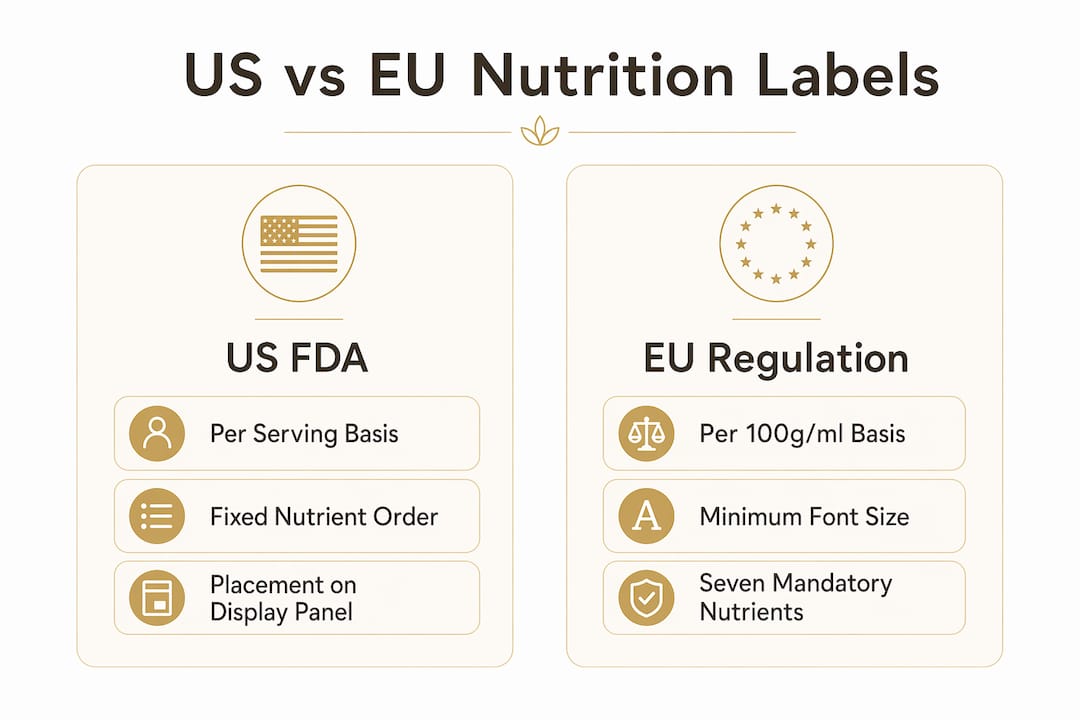
US labels express nutrient amounts per serving, and that serving size must align with the FDA’s Reference Amount Customarily Consumed, or RACC. Accurate nutrition labeling requires strict adherence to RACC definitions to produce meaningful per-serving data. A serving size that does not match RACC invalidates the entire label.
EU Regulation 1169/2011 requirements
The EU takes a per-100g or per-100ml approach rather than a per-serving basis. EU Regulation 1169/2011 mandates seven core nutrients: energy in kJ/kcal, fat including saturates, carbohydrates including sugars, protein, and salt. This regulation has been in effect since december 2016 and applies across all EU member states.
Legibility rules are strict. The EU requires a minimum font x-height of 1.2 mm to ensure nutrition information is readable. That is a non-negotiable legal minimum, not a design suggestion. Tabular format is the preferred layout under EU rules, though linear formats are permitted when space is limited.
Requirement | US (21 CFR Part 101) | EU (Regulation 1169/2011) |
Nutrient basis | Per serving (RACC) | Per 100g or 100ml |
Core nutrients required | 15+ including vitamins and minerals | 7 core nutrients |
Placement rule | Principal Display Panel or Info Panel | Tabular format preferred |
Font size minimum | Specific type size rules | 1.2 mm x-height |
Energy display | Calories (kcal) | kJ and kcal both required |
How do you accurately calculate nutritional values for menu items?
Accurate calculation starts with verified ingredient data. Guessing or estimating nutrient values from memory produces labels that fail audits and mislead guests.
Using verified ingredient databases
The USDA maintains an extensive ingredient catalog that gives food service managers a reliable starting point. The USDA database catalogs over 200,000 food items for accurate nutrient input, making it the most practical free resource for US operators. For EU operations, national food composition databases published by member state health authorities serve the same purpose.
The process works like this:
List every ingredient in the recipe with exact weights in grams.
Look up each ingredient in the USDA database or an equivalent verified source.
Record the nutrient values per 100g for each ingredient.
Multiply each nutrient value by the ingredient weight, then divide by 100 to get the nutrient contribution.
Sum all contributions to get the total recipe nutrition.
Divide by the number of servings to get per-serving values for US labels, or calculate per-100g values for EU labels.
Pro Tip: Never mix per-serving data from one source with per-100g data from another. Mixing these bases is the most common calculation error restaurant managers make, and it invalidates your label entirely.
Choosing the right calculation tools
Dedicated nutrition calculation software reduces manual errors significantly. Look for tools that let you build recipes from a verified ingredient library, apply recipe scaling automatically, and export results in both per-serving and per-100g formats. Digital menu platforms allow dynamic nutritional information updates, which reduces manual errors and keeps compliance maintenance manageable as menus change. This matters most for operations that rotate seasonal dishes or run frequent specials.
Spreadsheet-based calculations work for small menus but become error-prone at scale. A dedicated platform that integrates calculation with menu display removes the gap between your back-of-house data and what guests actually see.
What are the best practices for presenting nutrition data on menus?
Presentation is as important as precision. Improperly placed or illegible nutrition data leads to failed compliance, even when the underlying numbers are correct. The following practices apply whether you run a printed menu, a digital tablet menu, or a QR code menu.
Font size and contrast. Use a font size that meets or exceeds the legal minimum for your region. High contrast between text and background is not just good design. It is a legal requirement in the EU and a practical necessity everywhere.
Tabular format for dense data. When listing multiple nutrients, a table is cleaner and easier to scan than a paragraph. Guests read tables faster, and regulators prefer them.
Mandatory footnotes. US menus must include the % Daily Value footnote statement explaining that values are based on a 2,000-calorie diet. Omitting this footnote is one of the most common triggers for FDA warning letters.
Allergen emphasis. Bold or underlined allergen declarations are required under EU rules and strongly recommended everywhere. Allergen transparency often surpasses calorie disclosure in building customer trust and reducing liability risks.
Digital vs. print balance. Print menus have fixed space, so prioritize the most legally required nutrients and use a QR code to link to full nutritional details. Digital menus can display complete data without crowding the layout.
Pro Tip: Place allergen information in a visually distinct section, separate from the general nutrition table. Guests with allergies scan for this information first, and clear placement reduces the risk of a missed declaration.
For managers thinking about how their online presence supports compliance, presenting accurate nutritional data also signals credibility to guests who research restaurants before visiting.
What are the most common nutritional display mistakes and how do you fix them?
Even well-run operations make the same compliance errors repeatedly. Knowing where audits fail helps you fix problems before an inspector finds them.
Misplaced labels. Nutrition information buried in a menu appendix or printed in a font too small to read fails placement rules. Move the panel to the required location and verify font size against regional minimums.
Serving sizes that do not match RACC. A portion size based on what your kitchen plates is not the same as the FDA’s Reference Amount Customarily Consumed. Recalculate using the correct RACC for each food category.
Missing mandatory nutrients. Leaving out added sugars, vitamin D, or potassium from a US label is a direct violation. Run a checklist against the full 21 CFR Part 101 nutrient list before printing or publishing any menu.
No % Daily Value footnote. This single omission generates more FDA warning letters than almost any other labeling error. Add the standard footnote to every US-facing menu.
Outdated labels after recipe changes. When a supplier changes an ingredient or your kitchen adjusts a recipe, the nutrition data changes too. Build a review schedule into your operations calendar. Quarterly reviews catch most drift before it becomes a compliance issue.
The nutrition label overview for food service operations shows that staying current with regulatory updates is as important as getting the initial label right. Regulations evolve, and a label that was compliant two years ago may not meet current standards.
Key Takeaways
Accurate nutritional information display requires matching your calculation basis and label format to the specific regulatory framework governing your market.
Point | Details |
Know your regulatory framework | US labels use per-serving RACC basis; EU labels use per-100g or per-100ml basis. |
Use verified ingredient data | The USDA database catalogs over 200,000 items for reliable nutrient calculations. |
Never skip the footnote | The % Daily Value footnote is mandatory on US menus and its absence triggers FDA warning letters. |
Allergen emphasis is non-negotiable | Bold or underlined allergen declarations reduce liability and build more trust than calorie data alone. |
Digital menus reduce compliance drift | Dynamic update capability keeps nutritional data accurate as recipes and regulations change. |
Why I think most restaurants underestimate the allergen problem
After years of watching food service operations navigate compliance audits, the pattern I see most often is this: managers spend enormous energy getting calorie counts right and almost no energy on allergen presentation. The calorie number is visible. The allergen declaration is tucked into a footnote in 8-point type.
That is the wrong priority. A guest who consumes an undisclosed allergen faces a genuine health risk. A guest who sees an approximate calorie count faces a minor inconvenience. The legal and human stakes are not comparable. I have seen operations receive clean scores on nutrient accuracy and still face serious liability exposure because their allergen declarations were technically present but practically invisible.
The other thing I would push back on is the assumption that compliance is a one-time project. Menus change. Suppliers change. Regulations change. The operations that stay consistently compliant treat nutritional labeling as a living process, not a box to check at launch. Building a quarterly review into your standard operating procedures costs almost nothing and prevents the kind of drift that turns a minor oversight into an audit failure.
Technology helps here, but only if you use it correctly. A digital menu platform that lets you update nutritional data in real time is only valuable if someone is actually responsible for triggering those updates when a recipe changes. Assign ownership. Set a review schedule. The tool is only as good as the process behind it.
— Abhi
How Mydigimenu makes nutritional compliance easier for restaurants
Managing nutritional data across a full menu is genuinely complex work. Mydigimenu is built to make that complexity manageable for restaurant and food service managers who need accurate, up-to-date nutritional information in front of guests without rebuilding their menu every time something changes.
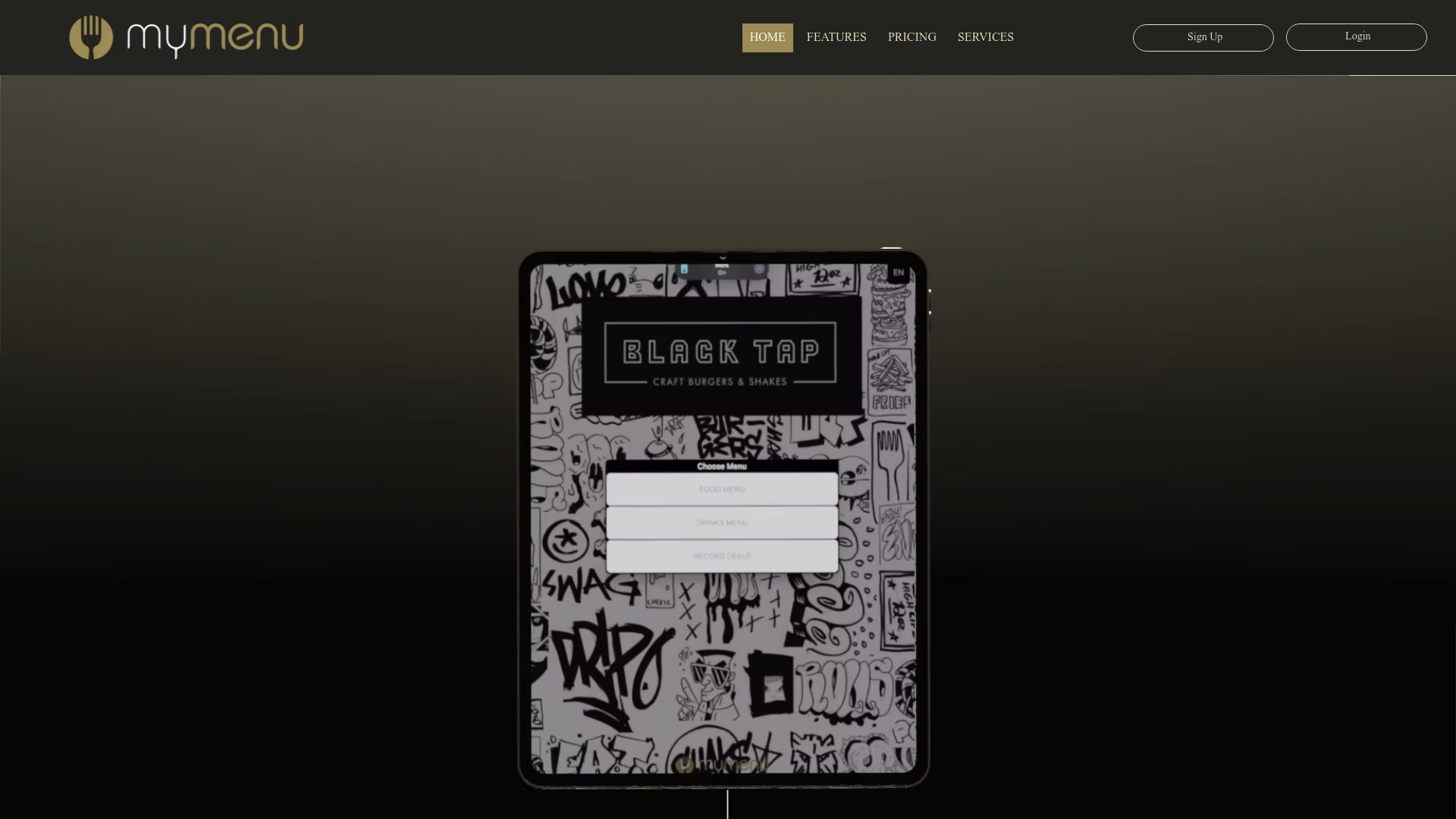
The platform supports detailed nutritional information display directly within digital tablet and iPad menus, so guests see accurate data alongside vivid food photography and descriptions. QR code menus give operators the ability to push real-time menu updates the moment a recipe or regulation changes, eliminating the lag that causes compliance drift. For managers ready to get started, current plans and pricing are available to fit operations of any size, from a single-location café to a multi-site restaurant group.
FAQ
What nutrients are required on a US restaurant nutrition label?
US regulations under 21 CFR Part 101 require calories, total fat, saturated fat, trans fat, cholesterol, sodium, total carbohydrate, dietary fiber, total sugars, added sugars, protein, vitamin D, calcium, iron, and potassium. All 15+ nutrients must appear in the specified order.
What is the difference between US and EU nutrition label formats?
US labels express nutrient values per serving based on the FDA’s Reference Amount Customarily Consumed, while EU Regulation 1169/2011 requires values per 100g or 100ml. Mixing these two bases in one label invalidates the data.
What font size does the EU require for nutrition labels?
The EU mandates a minimum font x-height of 1.2 mm for all nutrition declarations. This applies to both print and digital formats where the declaration is rendered as text.
Why do US menus need a % Daily Value footnote?
The % Daily Value footnote explains that nutrient reference values are based on a 2,000-calorie daily diet. Omitting it is one of the most frequent causes of FDA warning letters, making it a critical element of any compliant US nutrition label.
How often should restaurants update their nutritional information?
Restaurants should review and update nutritional data whenever a recipe changes, a supplier substitutes an ingredient, or a regulatory update takes effect. A quarterly review schedule catches most compliance drift before it becomes an audit issue.
Recommended
Comments