
What Is a Group Reservation System for Hotels?
- Abhi Bose
- 13 hours ago
- 8 min read

TL;DR:
A group reservation system consolidates multiple guest bookings under a single master record to manage bookings, billing, and inventory efficiently. It automates tasks such as quote generation, deposit tracking, and rooming list management, reducing processing time significantly. These systems improve revenue control and sales performance, especially when policies are well-defined and integrated with property management software.
A group reservation system is defined as specialized software that consolidates multiple guest bookings under a single master record, enabling hospitality teams to manage room blocks, event spaces, pricing, and billing from one central platform. Unlike standard booking tools, group reservation management handles the full lifecycle of a group arrangement: from the initial quote through deposit collection, rooming list ingestion, and final folio settlement. Group reservations typically involve 5–10 or more guests with negotiated rates and shared itinerary parameters. That scale creates coordination demands that standard property management systems (PMS) simply cannot handle alone, which is exactly why dedicated group booking software exists.
What is a group reservation system and how does it work?
A group reservation system works by creating a master booking record that links every individual guest reservation to a single agreement. The system holds room blocks or event space inventory, tracks deposit schedules, and generates quotes automatically. All of this connects in real time to the property’s PMS, so front desk staff always see accurate availability.
The operational mechanics break down into several core functions:
Master booking creation: The system opens a single contract record that governs all sub-reservations, including negotiated rates, room categories, and service inclusions.
Automated quote generation: Staff enter group parameters and the system produces a formatted proposal, cutting out manual calculation and formatting time.
Deposit and payment tracking: The platform records deposit receipts, flags upcoming payment deadlines, and alerts staff when final balances are due.
Rooming list management: Automated rooming list ingestion feeds guest names and room assignments directly into the PMS, reducing check-in errors and guest friction.
Folio billing: The system separates master account charges (such as meeting room fees) from individual guest folios, preventing billing disputes at checkout.
Release date management: The platform flags cut-off dates so unsold rooms return to general inventory before revenue is lost.
Group reservation software centralizes booking details, manages blocks, cut-off dates, rooming lists, and folio billing within the hotel PMS. That single source of truth eliminates the version-control chaos that comes from managing group bookings across email threads and spreadsheets.
Pro Tip: Automation in group reservation systems can reduce booking processing time by up to 90% compared to manual workflows. Redirect that recovered time toward upselling services and building client relationships.

What are the main types of group reservations in hospitality?
Group bookings are not one-size-fits-all. Hotels and restaurants configure them differently depending on the client, the event type, and the inventory at stake. Understanding the distinctions prevents costly errors.
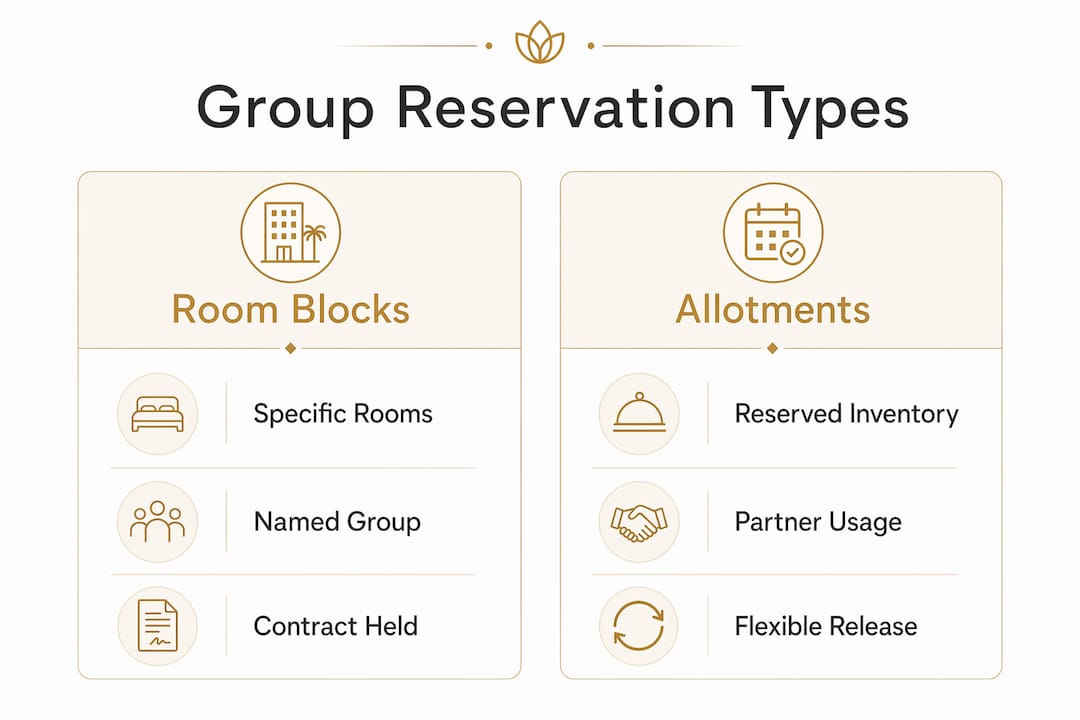
Room blocks and allotments serve different business purposes, and confusing them creates phantom availability or significant revenue leakage. A room block is a set of rooms held under a signed contract for a specific group. An allotment is inventory reserved for a partner, such as a travel agency, with agreed release rules. A master booking is the overarching record that ties all sub-reservations, services, and billing to one agreement.
Type | How it works | Best use case |
Room block | Specific rooms held under contract for a named group | Weddings, corporate retreats, sports teams |
Allotment | Inventory reserved for a partner with release rules | Travel agency partnerships, tour operators |
Master booking | Single record linking all rooms, services, and billing | Multi-day conferences, large family gatherings |
Group size thresholds vary by property, but most hotels define a group as 8–10 rooms or more. Restaurants typically apply group booking rules at 5 or more guests, triggering pre-set menus, deposit requirements, and dedicated server assignments.
Non-refundable deposits for group travel typically range from 25% to 50%, with final balances due 30–60 days before arrival. These terms protect the property against attrition while giving the group organizer a clear payment timeline. Building these rules directly into the reservation system removes the need for manual follow-up and reduces the risk of disputes.
Cut-off and release dates are the most overlooked configuration points. Missing a release date means unsold rooms stay blocked from general inventory, causing unrecoverable revenue loss and potential attrition penalties. A well-configured group reservation app automates release date alerts so no deadline slips through.
What are the benefits and challenges of group reservation systems?
The benefits of group reservation management extend well beyond administrative convenience. The right system reshapes how a property generates revenue from group business.
Core benefits include:
Fewer manual errors across rooming lists, billing, and rate application
Faster processing from inquiry to confirmed contract
Real-time inventory visibility for both sales and front desk teams
Coordinated multi-service management covering rooms, dining, and meeting spaces
Proactive sales capability through automated follow-up and proposal generation
“Group reservation technology transforms the group sales desk from reactive administrative tasks to a proactive sales engine driving revenue growth. Properties that treat group software as a cost-center miss its true function: it is a revenue tool.”
That perspective reflects a broader shift in how hospitality professionals view group desk technology. The best group booking systems do not just record reservations. They surface opportunities, flag at-risk bookings, and give sales managers the data they need to negotiate confidently.
The challenges are real, though. Group contracts are complex, and every property has unique policies around deposits, attrition clauses, and service inclusions. Configuring a system to reflect those nuances requires time and expertise. Staff training is non-negotiable. A system that front desk agents do not trust or understand will be bypassed in favor of email and spreadsheets, defeating the purpose entirely.
Integration with existing PMS or POS platforms is another friction point. Properties running older systems may face data mapping challenges that require technical support. The investment in setup pays off, but managers should plan for a realistic onboarding period of several weeks.
Pro Tip: The most common implementation mistake is skipping the policy definition phase. Before going live, document your deposit rules, cancellation terms, and release date logic in writing. Build those rules into the system before processing a single group booking.
How to choose and implement a group reservation system
Selecting the right group booking software starts with an honest assessment of your property’s current pain points. A 50-room boutique hotel managing three group bookings per month has different needs than a 400-room conference hotel running 30 concurrent group contracts.
Follow these steps to select and implement effectively:
Conduct a needs assessment. Map your current group booking workflow from inquiry to checkout. Identify where errors occur, where time is lost, and which manual steps could be automated.
Define your business rules. Document deposit percentages, payment deadlines, attrition thresholds, and cancellation policies before evaluating any software. Systems that cannot accommodate your specific rules are not viable options.
Evaluate multi-service capability. The best group booking systems handle rooms, dining, meeting spaces, and ancillary services under one master record. Confirm that any platform you consider supports multi-product booking management for your property type.
Verify PMS integration. Real-time inventory syncing between the group system and your PMS is non-negotiable. Request a live integration demo, not just a feature list.
Assess the user interface. Sales managers and front desk agents use these systems under pressure. A confusing interface increases errors. Involve frontline staff in the evaluation process.
Plan staff training. Schedule structured training before go-live, not after. Include scenario-based exercises covering rooming list uploads, release date management, and folio splitting.
Run a pilot group. Process one real group booking through the new system before full rollout. Use the experience to identify configuration gaps and refine your workflow.
Review reporting capabilities. Group sales reporting should show pickup pace, attrition risk, and revenue by segment. If the system cannot produce those reports, your sales team is flying blind.
Centralized sales management and clear reporting are what separate a capable group reservation app from a basic booking tool. Properties that automate hospitality operations consistently report faster response times to group inquiries and higher conversion rates from proposal to contract.
Key Takeaways
A group reservation system is the single most effective tool for converting complex, multi-guest bookings into predictable, well-managed revenue for hotels and restaurants.
Point | Details |
Core definition | A group reservation system consolidates 5+ guest bookings under one master record with shared rates and billing. |
Automation impact | Specialized systems reduce booking processing time by up to 90% compared to manual workflows. |
Know your booking types | Room blocks, allotments, and master bookings serve distinct purposes; confusing them causes revenue loss. |
Deposit and release rules | Configure 25–50% deposits and release dates directly in the system to protect revenue automatically. |
Implementation priority | Define business rules and verify PMS integration before selecting any group booking software. |
Why group reservation systems are more than just booking tools
I have spent years watching hospitality teams treat group reservation software as a glorified spreadsheet. That framing costs them money every single quarter.
The properties that get the most from these systems are the ones that hand ownership to their sales managers, not their IT departments. When a sales manager can generate a polished group proposal in minutes, respond to an inquiry the same day, and track every deposit without chasing emails, the system pays for itself in the first month. The technology is not the point. The speed and confidence it gives your sales team is the point.
The post-pandemic hospitality market accelerated demand for multi-service group bookings. Corporate clients now expect a single point of contact to handle rooms, dining, and meeting spaces simultaneously. A system that cannot link those services under one master record forces your team into manual coordination that clients can feel. Slow responses and billing errors do not just frustrate guests. They lose repeat business.
The misconception I hear most often is that group reservation software is too complex for smaller properties. The opposite is true. A 60-room hotel with a dedicated sales manager gains more from automation than a large chain with a full reservations department. The smaller team has less capacity to absorb manual work, so the efficiency gains hit harder and faster.
Treat your group reservation system as a sales tool. Configure it to reflect your actual policies. Train your team to use it with confidence. The properties that do this consistently outperform those that do not, and the gap is widening.
— Abhi
How Mydigimenu complements your group reservation operations
Group reservations fill your rooms and event spaces. What happens at the table is where the guest experience truly comes alive.
Mydigimenu gives restaurant and hotel dining teams a digital menu platform that works alongside your reservation system to deliver a polished, contactless dining experience for every group. From QR code menus that showcase mouthwatering food photography to CRM-connected guest profiles that remember preferences, Mydigimenu turns a group dinner from a logistical challenge into a memorable occasion. The platform supports multiple languages and currencies, making it a natural fit for international group clients. Explore Mydigimenu’s reservation features to see how digital dining tools can complete the group experience your guests expect.
FAQ
What is a group reservation system?
A group reservation system is software that manages multiple guest bookings consolidated under a single master record, handling room blocks, pricing, deposits, rooming lists, and billing from one platform. It integrates with a property management system to keep inventory accurate in real time.
How does group reservation work in a hotel?
A hotel group reservation starts with a master booking that holds a room block or event space under a negotiated contract. The system then tracks deposits, manages rooming lists, and releases unsold inventory before the cut-off date to protect revenue.
What is the difference between a room block and an allotment?
A room block holds specific rooms under contract for a named group, while an allotment reserves inventory for a partner such as a travel agency with agreed release rules. Confusing the two creates phantom availability and revenue leakage.
What are the main benefits of group reservation management?
The primary benefits include fewer billing errors, faster processing from inquiry to contract, real-time inventory visibility, and the ability to coordinate rooms, dining, and meeting spaces under one agreement. Automated systems also free sales teams to focus on revenue-generating activities rather than data entry.
When are deposits required for group bookings?
Industry practice sets non-refundable deposits at 25–50% of the total group value, with final payment due 30–60 days before arrival. Building these terms into your group reservation app automates follow-up and reduces the risk of late or missed payments.
Recommended