
Multilingual menus: Unlock engagement for every guest

TL;DR:
Multilingual menus serve as a crucial first impression, reducing guest anxiety and boosting satisfaction across diverse populations. They enhance operational efficiency, deepen emotional loyalty, and expand market reach by respecting cultural and language differences. Thoughtful, accessible digital implementation ensures meaningful inclusion that benefits both guests and venue reputation.
A menu landing on the table is not a formality. It is the first real test of whether your venue feels welcoming or alienating to a guest who speaks a different language, and that test happens silently, within seconds, before a single server appears. Most restaurant and hotel managers invest heavily in décor, training, and plating, yet overlook the quiet power of language access in the dining experience. Multilingual menus are not a luxury add-on for international resorts. They are a foundational guest experience tool, and the venues that treat them that way are pulling ahead in satisfaction scores, repeat visits, and revenue per cover.
Table of Contents
Key benefits: More guests, better reviews, and less staff friction
Accessibility and compliance: Getting it right with technology
Implementation strategies: Digital systems, workflows, and real-world tips
What most hospitality leaders overlook about language inclusion
Connect your guests with multilingual digital menu solutions
Key Takeaways
Point | Details |
Boost guest comfort | Multilingual menus reduce confusion and make all guests feel welcome. |
Increase market reach | Translated menus attract more diverse guests, broadening your client base. |
Limit reputation risk | Providing menu translations lowers backlash risk and strengthens community perception. |
Ensure true accessibility | Proper digital menus follow accessibility standards for all users—including those with assistive technologies. |
Maintain menus efficiently | Digital workflows make updating and managing multilingual menus a smooth, ongoing process. |
The hidden power of multilingual menus in hospitality
A menu is far more than a catalog of dishes and prices. It is a narrative, a guide, and a promise all rolled into one physical or digital touchpoint. When that touchpoint speaks a guest’s language, something shifts. Anxiety drops. Curiosity rises. The willingness to explore the menu, try something unfamiliar, or add a recommended pairing grows noticeably. When it does not speak their language, guests often default to the safest, most recognizable item, order less, and leave feeling slightly out of place, even if the food was excellent.
This dynamic is especially powerful in globalized destinations where international travelers and local expat communities make up a significant share of covers. Multilingual signage and messaging in hotels can lower confusion and anxiety and make guests more likely to explore and confidently navigate the property, and that principle extends directly to dining menus and meal specials. The guest who feels oriented and understood is the guest who orders the chef’s special, lingers for dessert, and returns next visit.
“Language access is not just a courtesy. It is a signal that your venue sees its guests as individuals, not as a homogeneous group to be processed.”
Consider how this plays out in practice. A couple visiting from South Korea arrives at a beachside resort. The breakfast buffet signage is in English and German only. They guess at options, skip the egg station because they are unsure of the ingredients, and eat less than they would have otherwise. No complaint is ever filed. The manager never knows. But the post-stay survey rating for “dining experience” comes in lower than expected, and the couple books a competitor for their next trip. That invisible loss is what multilingual menus prevent.
Venues that treat their menus as digital tools for guest engagement report stronger emotional connections with diverse clientele. Guests who feel seen through their native language tend to spend more time exploring menu options, ask more questions, and engage more warmly with staff. Inclusive language choices also reinforce the kind of restaurant identity and unique experiences that inspire word-of-mouth referrals in today’s social media landscape.
Key reasons multilingual menus transform the guest journey:
They reduce ordering anxiety for non-native speakers, leading to more confident and satisfying choices
They signal cultural respect, which builds emotional loyalty faster than most loyalty programs
They increase upsell potential when guests can fully understand and appreciate dish descriptions
They lower the burden on service staff, who no longer need to verbally translate or guess at comprehension
They open your venue to expat communities, language-minority locals, and international tour groups who might otherwise choose a competitor
Key benefits: More guests, better reviews, and less staff friction
The strategic value of multilingual menus becomes even clearer when you examine the concrete operational and reputational gains. Broadening your language reach is, at its core, a market expansion decision. Travelers, expats, and non-native-speaking local residents represent a massive and often underserved dining audience. Capturing even a fraction of that audience through language inclusion can meaningfully shift your revenue mix over a quarter.
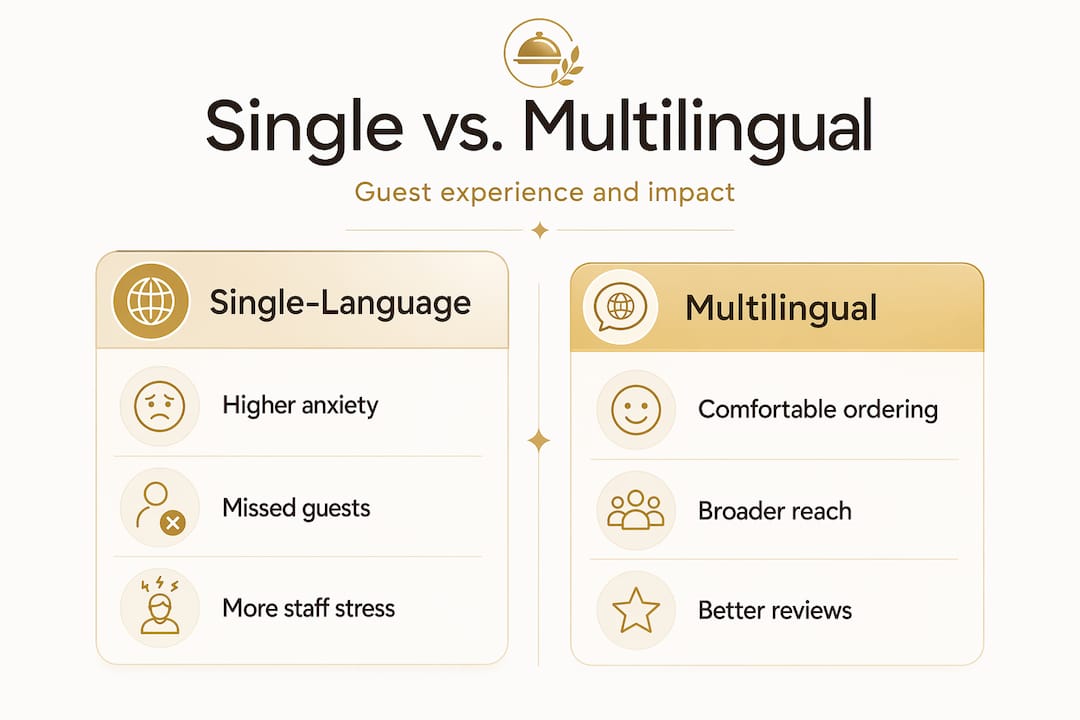
Reputation is the other major lever. Restaurants with single-language menus risk reputational and community backlash, and adding translations can mitigate that backlash while expanding the reachable audience. This is not a hypothetical. Venues that have faced public criticism over exclusionary menus have seen review scores dip and foot traffic slow, sometimes for months. The good news is that correction is straightforward and the recovery is fast when multilingual options are added thoughtfully.
Factor | Single-language menu | Multilingual menu |
Guest anxiety at ordering | Higher for non-native speakers | Significantly reduced |
Average items ordered | Fewer, safer choices | More explorative orders |
Staff translation time | High, inconsistent | Minimal, standardized |
Review sentiment from diverse guests | Mixed or negative | Consistently stronger |
Market reach | Narrower | Broader, including expats and tourists |
Content update speed | Slow, costly reprinting | Instant with digital systems |
Operationally, digital multilingual menus cut one of the most underappreciated inefficiencies in hospitality: verbal translation by staff. When a server must explain every dish in a second language, service slows, errors increase, and guest confidence in the recommendation wavers. A clear, beautifully translated digital menu frees your team to do what they do best: connect with guests, recommend thoughtfully, and deliver hospitality rather than act as interpreters.
Pro Tip: Invest in professional translation for your top 15 to 20 signature dishes first. Guests remember the items they order most, and a polished, culturally nuanced description of your flagship dishes creates a stronger impression than a rushed translation of the entire menu.
Strong menu design strategies pair naturally with multilingual support. When guests can navigate a well-structured, visually appealing menu in their own language, conversion from browsing to ordering accelerates. That acceleration shows up directly in table turn efficiency and revenue per cover, two metrics every manager tracks.
Venues aiming for authentic guest experiences, like those following an authentic restaurant checklist, understand that language is part of authenticity. A menu that invites rather than excludes signals confidence in the food and respect for the guest.
Accessibility and compliance: Getting it right with technology
Multilingual menus are only effective when they are genuinely usable, and that means going beyond simply offering translated text. Digital menus must meet accessibility standards to serve all guests equally, including those who rely on screen readers, voice assistants, or other assistive technologies.

The Web Content Accessibility Guidelines (WCAG) establish clear requirements for digital content. One often overlooked rule is language identification: multilingual menus are most effective when implementation accounts for accessibility and correct language identification in digital menu systems, especially for assistive technologies. In practical terms, this means each language block within your digital menu should be programmatically tagged so that a screen reader automatically switches to the correct pronunciation and reading rules. A screen reader encountering Japanese text while set to English mode will produce garbled output, effectively locking out visually impaired guests.
Common digital menu accessibility pitfalls:
Issue | Impact | Fix |
Missing language tags | Screen readers mispronounce content | Tag each section with correct ISO language code |
Low color contrast in translated text | Poor readability for low-vision guests | Use WCAG-recommended contrast ratios |
Non-scalable font sizes | Text too small on mobile for some guests | Enable text scaling in your platform settings |
Images without alt text in any language | Invisible to screen readers | Add descriptive alt text in all active languages |
Auto-translate without review | Cultural errors and inaccuracies | Always have a fluent speaker review translations |
Steps to ensure your digital multilingual menu is truly accessible:
Choose a digital menu platform that supports programmatic language identification (ISO 639 language codes) at the section level
Test each language version with a screen reader tool to verify correct pronunciation and navigation
Verify color contrast ratios for all text in every language, not just your primary language
Ensure all food images carry descriptive alt text translated into each active language
Review an accessibility statement example to understand what documentation your venue may need to publish
Schedule a quarterly accessibility audit to catch issues introduced during content updates
Accessibility compliance is not just a legal or ethical checkbox. It is a competitive signal. Guests with disabilities travel in large numbers and are acutely aware of which venues genuinely accommodate them. A venue that gets both language and accessibility right earns powerful loyalty from a guest segment that is often underserved.
Implementation strategies: Digital systems, workflows, and real-world tips
Understanding why multilingual menus matter is one thing. Building the operational infrastructure to deliver and sustain them is another. The most common mistake venues make is treating multilingual menus as a one-time project rather than an ongoing operational discipline.
Digital signage and menu systems for hotels and resorts can switch languages on demand, reducing staff translation load and keeping content current across all venues. That capability transforms a logistical burden into a streamlined workflow, but only if the underlying processes support it.
Here is a practical implementation roadmap:
Audit your current guest demographics to identify the top three to five languages spoken by your clientele, using reservation data, survey responses, and booking platform analytics
Select a digital menu platform that supports multiple language versions from a single content management interface, allowing one update to propagate across all language variants instantly
Engage professional translators, not machine translation alone, for your menu descriptions, particularly for dishes with cultural context or nuanced ingredients
Build a language update checklist that mirrors your regular menu update process, so every price change, allergen update, or seasonal special is reflected in all language versions simultaneously
Train front-of-house staff on how guests can switch languages on the digital menu, turning language selection into a warm, welcoming moment rather than a technical hurdle
Use video menus alongside translated text to bridge comprehension gaps visually. A mouthwatering video of your signature dish communicates deliciousness across any language barrier.
Pro Tip: Build your translation workflow into your menu update standard operating procedure from day one. Every time a new dish is added or a price changes, the translation step should happen automatically, not as an afterthought. This discipline prevents the frustrating situation where your English menu is current but your Mandarin version still shows last season’s pricing.
Additional operational considerations worth building into your plan:
Partner with local cultural organizations or university language programs for cost-effective translation review
Use your menu customization workflow to create modular content blocks that can be toggled by language without rebuilding the entire layout
Gather specific feedback from non-English-speaking guests about translation clarity and cultural accuracy, then iterate
Consider the benefits of digital booking and ordering integration, where multilingual support can extend from the menu all the way to the reservation confirmation and post-visit follow-up
What most hospitality leaders overlook about language inclusion
Here is the uncomfortable truth that most multilingual menu conversations skip: translation is not inclusion. A menu that has been mechanically converted from English to Spanish or Mandarin but fails to carry the warmth, cultural resonance, or culinary storytelling of the original is still a barrier. It is just a polite-looking one.
The best operators understand that language inclusion is a brand value, not a feature. It requires ongoing commitment, cultural humility, and a genuine curiosity about the guests you are serving. That means acknowledging that language coverage decisions can be politically and socially sensitive in certain markets, and that offering translations may delight the majority while prompting pushback from guests who prefer the original-language experience. Navigating this tension requires local insight, not a one-size-fits-all policy.
Some venues have learned this the hard way: rushing multilingual rollouts without community consultation, deploying machine-translated menus with culturally tone-deaf descriptions, or adding so many language options that the menu becomes visually overwhelming and harder to use for everyone. The solution is not to avoid multilingual menus. The solution is to invest in doing them thoughtfully.
Your menu customization perspective should include a clear stakeholder map: who are the guests you are serving, what languages do they actually speak at home rather than just travel in, and what cultural nuances shape how food descriptions should be written? Answering those questions honestly, and revisiting them regularly as your guest mix evolves, separates truly guest-centric operations from venues that are merely checking a box.
The most forward-thinking managers we see are not asking “how many languages should we add?” They are asking “how do we make every guest feel that this menu was written for them?” That shift in framing, from quantity of languages to quality of connection, is where real competitive advantage lives.
Connect your guests with multilingual digital menu solutions
Multilingual menus are most powerful when they are built on a platform that makes implementation fast, updates effortless, and the guest experience intuitive. MyDigiMenu.com is built precisely for this challenge, offering hospitality venues a digital menu ecosystem that supports multiple languages and currencies from a single, elegantly managed interface.
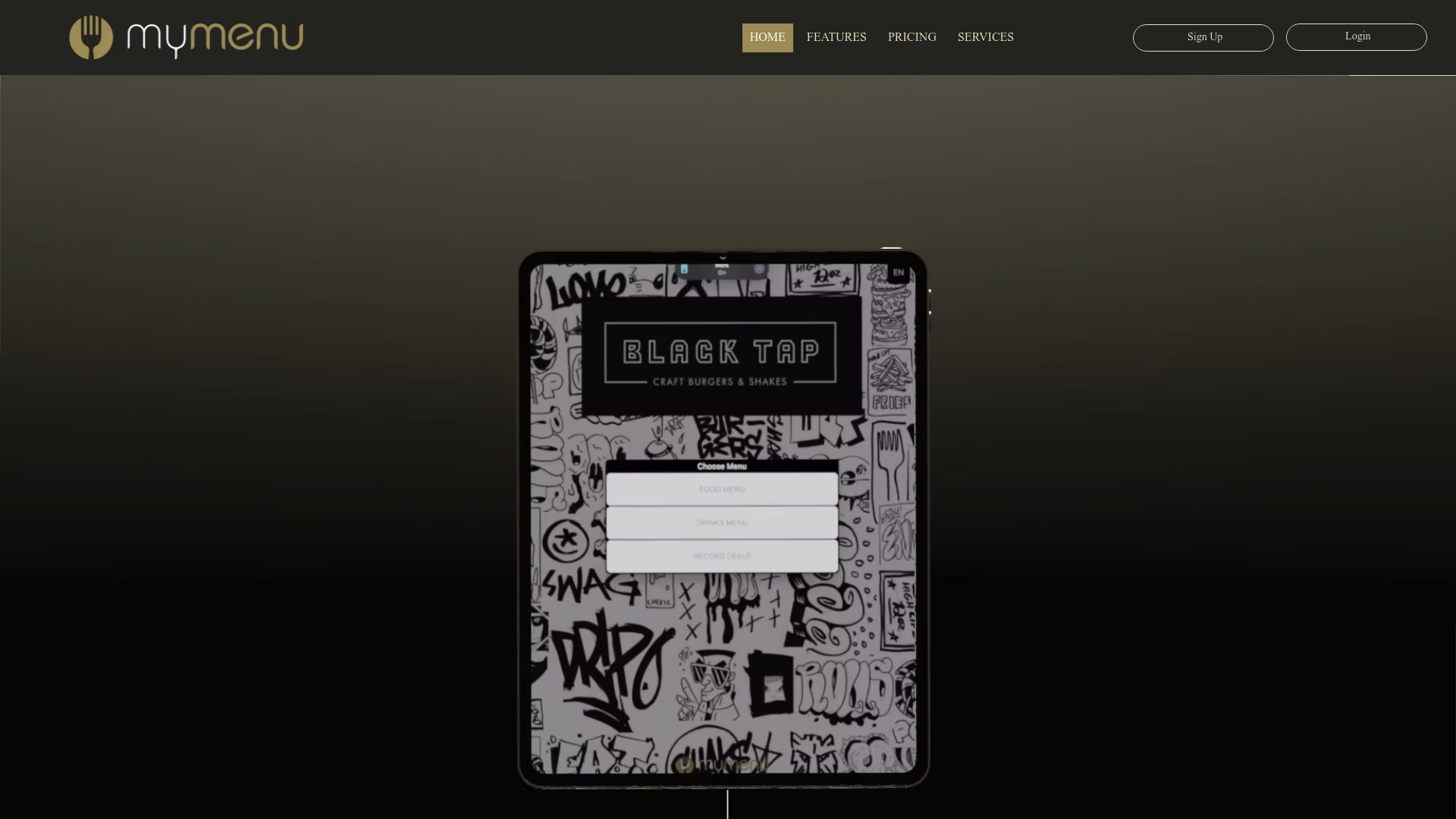
Whether you need digital restaurant menu solutions for your tablets, a QR menu generator that guests can access without downloading an app, or a clear view of digital menu pricing to plan your rollout, MyDigiMenu.com gives you the tools to transform language inclusion from an aspiration into a daily operational reality. A dash of digital can turn everyday service into extraordinary memories, and for your international guests, that transformation starts the moment they scan a QR code and see their language appear on screen.
Frequently asked questions
Which languages should I include on my restaurant menu?
Prioritize the languages most commonly spoken by your actual guest base, drawing on reservation data and post-visit surveys, and always include English as a global accessibility baseline. Review and update your language selection at least twice a year as your guest demographics evolve.
How can digital menus make multilingual updates easier?
Digital menu systems let you switch languages and push content updates instantly across all versions without reprinting, which is especially valuable for daily specials, allergen changes, or price adjustments that affect multiple language variants at once.
What accessibility standards must digital multilingual menus meet?
Your menus should follow WCAG guidelines, particularly the requirement that digital menu language be programmatically defined so screen readers and assistive technologies interpret each section correctly and deliver accurate pronunciation to visually impaired guests.
Could offering translations cause community backlash?
Adding translations can occasionally surface differing opinions in culturally sensitive markets, so the wisest approach is to align your language choices with documented guest needs, local community norms, and clear communication about your inclusivity values.
Recommended
Comments