
Why "Roast Grandmother" Ends Up on Real Menus
- Abhi Bose
- 40 minutes ago
- 10 min read

Menu translation mistakes almost always trace back to three things: restaurants change their menus faster than anyone can afford to translate them properly, owners lean on free machine translation to fill the gap, and literal word-for-word conversion can’t carry cultural meaning across languages. That combination produces the “roast grandmother,” the “husband and wife lung slice,” and the “Wang has intestines” moments that light up social media and occasionally, a country’s tourism board.
This guide gets you both halves of that story. You’ll find a curated set of real, representative menu-translation fails grouped by the kind of error that caused them, a breakdown of why these mistakes keep happening even at established restaurants, and a set of copy-paste fixes for the most common error types. There’s also a practical checklist with realistic cost and timeline ranges, plus a look at how platforms like Mydigimenu’s multilingual menu tools fit into a workflow that catches errors before they reach a diner’s table. South Korea’s government even stood up a task force for this exact problem, which tells you it’s not just a punchline. It’s a business issue with a paper trail.
Key Takeaways
Menu translation mistakes happen when operational cost pressure and unreviewed machine translation collide with cultural context that literal conversion can’t capture.
Point | Details |
Root cause is operational | Frequent menu changes push owners toward free machine translation instead of professional review. |
Literal accuracy isn’t the goal | Transcreation for appetite appeal outperforms word-for-word translation for customer trust and order value. |
Allergen language needs separate QA | Translated allergen statements require dedicated review since errors here create safety risks, not just embarrassment. |
Build a glossary before you translate | A shared glossary keeps dish names and terms consistent across every language and location. |
Centralize your menu content | Mydigimenu’s multi-language platform updates translations across QR, tablet, and web menus from one dashboard, cutting the risk of mismatched versions. |
Table of Contents
Menu Translation Mistakes That Went Viral (and Why)
The internet’s favorite menu fails aren’t random. They cluster into a handful of recognizable error types, and once you can name the pattern, you start spotting it everywhere from Bangkok to Barcelona.
Literal machine translation. This is the most common category, and it produces gems like “curried grab” instead of “curried crab” and “fried crap stick” where “crab” simply lost a letter to a bad OCR scan or a rushed typist. Rough Guides has documented dozens of these across menu fails from around the world, and the pattern is almost always the same: software translates each word correctly in isolation, then assembles them into nonsense because it has no concept of culinary phrasing.
Original: “Roast grandmother” (a mistranslation of a Korean or Chinese term for “roast pork” or a grandmother’s-recipe-style dish)
Likely error: A homophone or character mix-up in the source language got translated literally instead of contextually
Fixed version: “Grandma’s Style Roast Pork”
Cultural false friends and idioms. Some words translate perfectly and still mean the wrong thing. “Husband and wife lung slice” is a real Sichuan dish (fuqi feipian), a cold beef and offal appetizer named after the couple who invented it, not a literal reference to lungs on a plate for two. Rendered word-for-word into English, it reads like a threat instead of a menu item.
“The name comes from the vendors who created it, a husband-and-wife team in 1930s Chengdu, not from any literal ingredient list involving lungs as the centerpiece.” This is the exact trap literal translation falls into: technically accurate, culturally meaningless.
Original: “Husband and Wife Lung Slice”
Likely error: A dish name honoring its creators got translated as if every word were an ingredient
Fixed version: “Sichuan Sliced Beef in Chili Oil (Fuqi Feipian)”
Ingredient and term mistranslation. This category is where things get genuinely risky, not just funny. “Wang has intestines” is a viral example where a chef’s surname (Wang) got fused with a dish description in a way that reads like an accusation rather than an ingredient list. Similar errors show up when software translates “cream” as a dairy product when a menu means “creamed” in the sense of texture, or when a fish name gets rendered as an unrelated animal because the two words share a character or root.
Original: “Wang Has Intestines” (based on a viral Chinese-to-English menu translation)
Likely error: A proper name got parsed as part of the dish description
Fixed version: “Chef Wang’s Braised Pork Intestines”
Formatting and line-break errors. Sometimes the words are all correct and the meaning still collapses because of punctuation or word order. A missing comma or a translated line break can turn “slow-cooked, chicken and rice” into “slow, cooked chicken and rice,” implying the chicken itself is slow rather than the cooking method. The Atlas Obscura report on failed menu translations notes that many of these errors happen not in the translation itself but in how the translated text gets pasted back into a template that wasn’t designed to hold it.
Institutional recognition: South Korea’s task force. These aren’t just internet jokes to the businesses and governments trying to attract international visitors. After research found a striking rate of errors in restaurant menus translated for foreign tourists, South Korea set up a government task force specifically to fix embarrassing English translations, building a reference site restaurants could consult before printing a new menu. Viral posts of badly translated Arabic and Chinese menus have prompted similar grassroots corrections, with native speakers stepping in on social media to fix restaurant signage after a post gains enough traction.

Why These Mistakes Happen: The Real Operational Story
Every one of those examples has a business reason behind it, and it usually isn’t laziness. It’s arithmetic.
Restaurant menus change constantly, sometimes nightly for specials, sometimes seasonally for entire sections. Professional translators note that this turnover makes it impractical to send every update to a human translator, and that pressure is what pushes owners toward free machine-translation tools for a quick fix, according to reporting from Atlas Obscura. A $12 appetizer doesn’t justify a $150 translation invoice every time the kitchen swaps an ingredient, so the math tilts toward Google Translate and a prayer.
Several forces compound that pressure:
Rapid menu turnover makes per-update professional translation feel financially unjustifiable for small and mid-size operators.
Cost pressure pushes owners toward free machine translation instead of even a light human review pass.
No glossary or style guide means the same dish gets translated differently every time someone touches the menu, creating inconsistency across print, digital, and delivery-platform listings.
Cultural mismatch means literal accuracy and appetite appeal are two different goals, and machine translation only optimizes for the first one.
Localization specialists frame this as a marketing problem, not just a language problem: a menu’s job is to make food sound appealing and trustworthy, and transcreation consistently outperforms literal translation on that measure, including its effect on average order value.
That reframing matters. A translated menu isn’t a legal document that needs word-for-word fidelity. It’s a sales tool, and the South Korea task force example shows that governments now treat menu quality as connected to tourism revenue and national reputation, not just individual restaurant embarrassment. When a mistranslation goes viral, the damage isn’t confined to one restaurant’s Yelp page. It becomes a symbol for an entire country’s hospitality standards, fairly or not.
Common Menu Translation Errors and Quick Fixes
You don’t need a linguistics degree to catch most of these before they go to print. Here’s a breakdown of the recurring error types and a fix you can apply the same day.
Literal machine translation. The fix is never to publish raw machine output. Run it through a native speaker, even a bilingual staff member, before it reaches a customer.
Bad: “Explode fried intestines”
Fixed: “Crispy Fried Pork Intestines”
False friends and idioms. Dish names rooted in history, geography, or a founder’s name need a short explanatory phrase, not a literal conversion.
Bad: “Ants Climbing Tree”
Fixed: “Sichuan Glass Noodles with Minced Pork (‘Ants Climbing Tree’)”
Ingredient ambiguity. When a word has multiple meanings (like “cream” as a noun versus a cooking method), specify the dish format explicitly.
Bad: “Cream Corn Soup” (unclear if it contains dairy for allergy purposes)
Fixed: “Corn Soup with Cream (Contains Dairy)”
Tone and appeal loss. A technically correct translation can still sound clinical or off-putting. “Boiled Cow Stomach” is accurate and unappetizing; “Slow-Simmered Tripe in Herb Broth” sells the same dish.
Formatting and line-break issues. Never translate text that’s been flattened into an image or PDF, since software can’t parse table structure and often merges unrelated lines. Keep source menus in editable text so translated phrases land in the right column and row.
Allergen omissions. This is the highest-stakes category. Literal translation can accidentally drop or blur allergen language, and localization guides specifically warn that allergen statements need separate review from the rest of the menu, since a missed nut or shellfish reference is a safety issue, not a style one.
Pro Tip: Before publishing any translated menu, have one native speaker read it aloud to another native speaker who hasn’t seen the source text. If the listener has to ask “wait, what dish is that?”, the translation has failed regardless of how accurate it is on paper.
Your Menu Localization Checklist: Steps, Cost, and Timeline
A translated menu that actually works comes from a workflow, not a single translation event. Here’s the sequence that catches errors before they become a screenshot on someone’s phone.
Prepare the source text. Extract the menu into clean, editable text rather than working from a flattened PDF or a photo of the print menu.
Decide how to handle proper names and regional dish names. Choose whether dishes like “Fuqi Feipian” keep their original name with an English descriptor, or get fully renamed.
Build a glossary before translating anything. Lock in consistent terms for recurring ingredients, cooking methods, and house specialties across every language version.
Run an initial translation pass. Use a hybrid approach: an AI or CAT tool for a first draft, which operational guides recommend as the fastest way to get a workable starting point.
Get native-speaker review. A fluent speaker who didn’t write the draft catches phrasing that’s grammatically fine but culturally odd.
Validate with the chef or kitchen lead. Someone who actually knows the dish should confirm ingredient lists and preparation descriptions before anything goes live.
Run final QA on formatting. Check line breaks, allergen call-outs, and pricing alignment across every translated version.
Publish and assign an owner. One person should be responsible for every future update so the glossary stays intact.
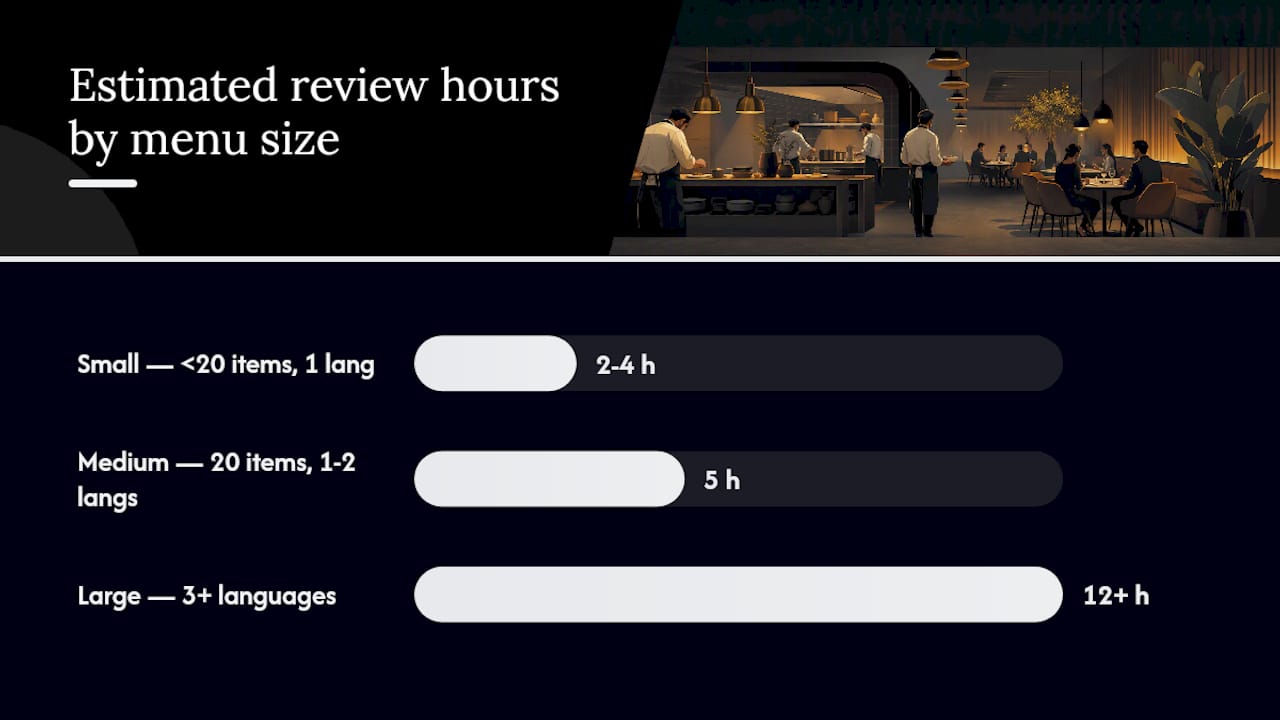
Cost and timeline depend on menu size, number of target languages, and whether allergen or legal review is required. A short café menu translated into one additional language with a hybrid AI-plus-review workflow tends to move faster and cost less than a full multi-page restaurant menu translated into four or five languages with dietary certification needs. Complex allergen language, regional dish names requiring cultural research, and multi-location consistency all add time on top of the base translation work.
Menu Size | Estimated Review Hours | Suggested QA Steps |
Small (under 20 items, 1 language) | 2 to 4 hours | Native review, glossary check |
Medium (20 items, 1 to 2 languages) | 5 hours | Native review, chef validation, allergen pass |
Large (3+ languages) | 12+ hours | Full glossary build, native review per language, chef validation, formatting QA |
Keep the source file in editable format from day one. Menus that start as designed PDFs create extra work later because every future update requires re-extracting text instead of simply editing a live document.
Better Tools Than Google Translate Alone
Four broad approaches exist for getting a menu translated, and they land on very different points of the cost-versus-reliability spectrum.
DIY machine translation costs nothing and takes minutes, but it’s the source of nearly every viral fail in this article. It has no concept of dish history, regional naming conventions, or allergen precision.
Professional human translation is the most reliable option and the most expensive, particularly when menus change often, since every update means another invoice.
Hybrid AI plus native-speaker review splits the difference: a machine or CAT tool produces the first draft, then a native speaker fixes tone, idiom, and cultural fit. Vendor research on translation-memory tools shows this approach consistently avoids the culturally awkward outputs that come from relying on machine translation alone.
Platform-enabled workflows center the menu content in one system rather than scattering translated text across print files, a website, and third-party delivery apps that each get updated separately. This is where a digital menu platform earns its keep. Mydigimenu supports multi-language and multi-currency menus from a single centralized dashboard, so when a dish name or description changes, it updates everywhere at once instead of requiring five separate edits across five separate files. QR-based and tablet menus built on this kind of system mean a corrected translation goes live immediately rather than waiting for a reprint, and chain restaurants managing multiple locations benefit even more, since a shared glossary keeps terminology consistent across every branch rather than letting each location invent its own translations.
Pro Tip: Build your glossary once, inside whatever platform holds your menu content, and reuse it every time you add a language or a new dish. A translation memory that remembers your house style for “slow-braised” or “family recipe” saves real time on every future update and keeps your tone consistent across five languages instead of just one.
Restaurant trends pieces increasingly treat multilingual menu accuracy as a baseline expectation rather than a bonus feature, a shift documented in industry coverage of what chefs need to prioritize going into 2026.
A Note From the Author
I’ve spent enough time squinting at menus in unfamiliar languages to know that a bad translation isn’t just funny, it’s a small moment of doubt for a customer trying to decide whether to trust your kitchen. Working with restaurant operators on digital menu systems, the pattern is consistent: the businesses that get translation right treat it as an ongoing workflow, not a one-time project they can forget about after launch.
How Mydigimenu Keeps Your Menu Accurate in Every Language
Every fix in this guide points to the same root problem: menu translation breaks down when content lives in too many disconnected places, edited by too many different people, with no shared reference point. A print menu, a PDF on your website, and a third-party delivery listing can all say something slightly different about the same dish, and each version is a chance for an error to slip through.
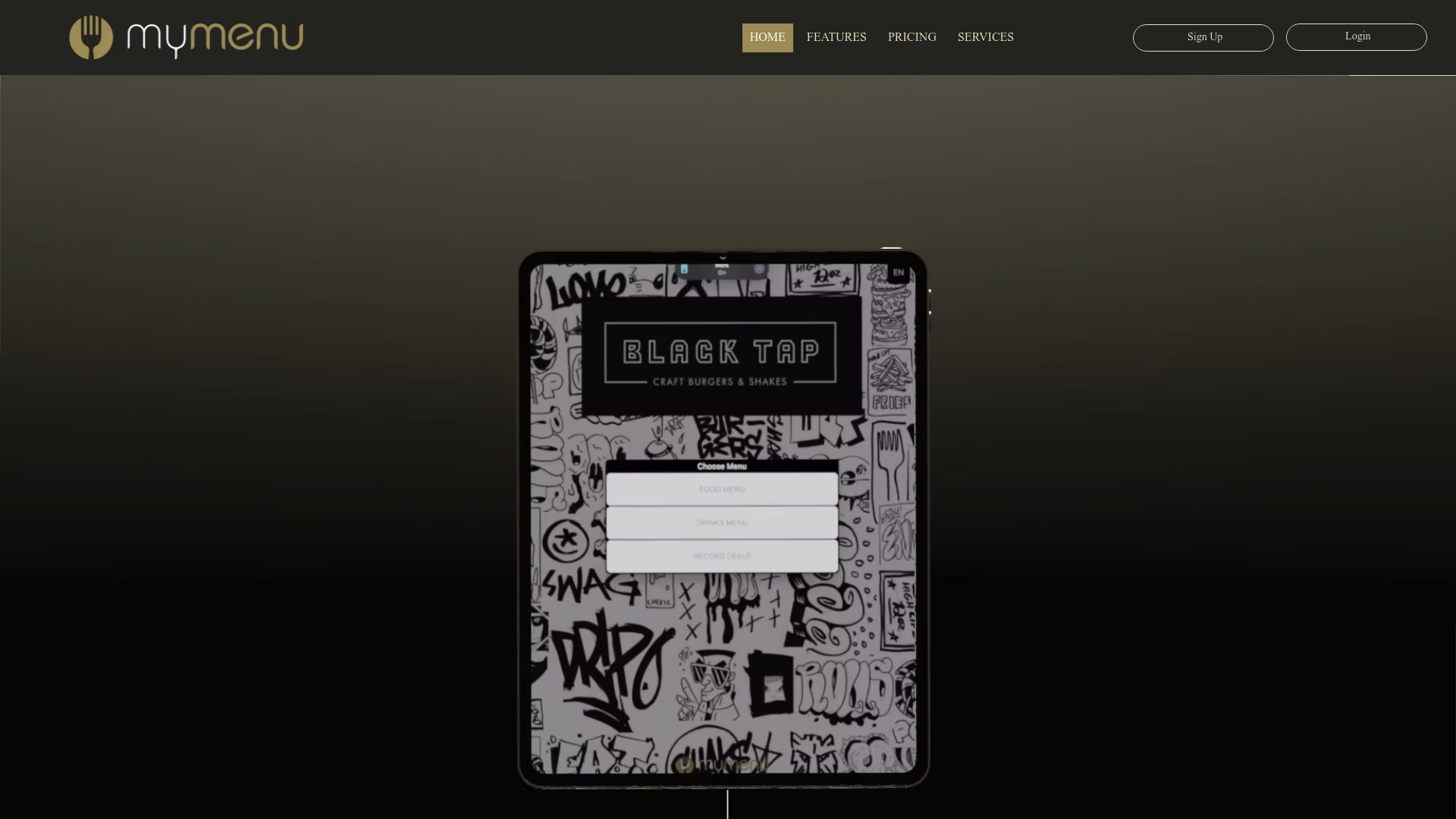
Mydigimenu solves this by giving you one centralized menu that updates across every touchpoint at once. Build your glossary a single time, translate your menu into as many languages and currencies as your guests need, and push a correction live in minutes rather than waiting for a reprint. QR code menus, tablet menus, and mobile ordering all pull from the same source, so a fixed translation shows up everywhere simultaneously instead of requiring five separate edits. That’s a meaningfully different operational model than juggling a static PDF, a website builder, and a delivery app dashboard that don’t talk to each other.
If your menu currently exists as three different files with three different translation histories, start by exploring Mydigimenu’s tablet and digital menu options or check the QR menu generator to see how quickly a corrected translation can go live. Review the pricing plans to find the tier that matches your menu size and language needs.
Sources
Recommended
Comments