
What is integration with delivery platforms: a guide for restaurants


TL;DR:
Delivery platform integration connects restaurants’ systems directly to third-party services, streamlining order flow and tracking. It involves APIs, menu synchronization, order routing, and unified reporting, significantly transforming daily operations. Choosing between custom and ready-made solutions depends on flexibility needs, scalability, and long-term adaptability to support growth.
Most restaurant owners assume that connecting to a delivery platform is like plugging in a USB drive. A few settings, a quick test, and orders start flowing. The reality of what is integration with delivery platforms is far more layered than that. It touches your tech stack, your kitchen workflow, your customer communication, and ultimately, your ability to grow. Understanding delivery platform integration is not just a technical exercise. It is one of the most consequential operational decisions your restaurant will make in 2026.
Table of Contents
Technical challenges and architectures of delivery platform integration
How integrated delivery platforms transform restaurant operations
Choosing the right integration approach: ready-made vs. custom-built
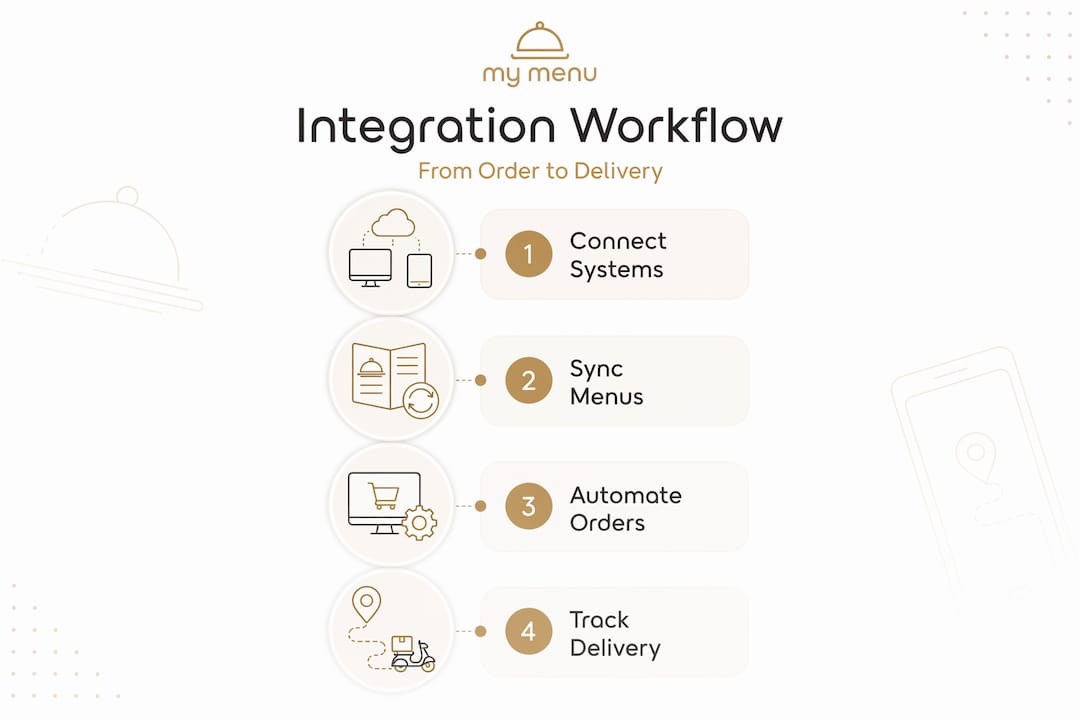
Practical steps to integrate delivery platforms into your restaurant workflow
Why delivery platform integration is more than tech — it’s a strategic growth enabler
How MyDigiMenu supports delivery platform integration for your restaurant
Key Takeaways
Point | Details |
Integration streamlines operations | Linking your order system with delivery platforms automates and simplifies delivery management. |
Architecture affects flexibility | API-first and middleware reduce complexity and ease future changes in integration. |
Unified dashboards improve visibility | Consolidated delivery data helps manage orders and improve customer communication. |
Choose integration wisely | Ready-made solutions offer scalability while custom builds may increase maintenance risk. |
Integration drives growth | Beyond tech, integration improves operational resilience and guest satisfaction. |
What delivery platform integration means for restaurants
At its core, delivery platform integration is the process of connecting your restaurant’s existing order management or point-of-sale (POS) system directly to third-party delivery services, so that orders flow automatically without staff manually re-entering them. Think of it as building a live bridge between your kitchen and every courier waiting at the curb.
Delivery integration connects an ordering platform with delivery partners, automating shipping logistics and providing real-time tracking for both the restaurant and the customer. That definition sounds simple, but what it means operationally is significant.
Here is what true delivery integration typically includes:
API connections: Application programming interfaces (APIs) are the technical channels that allow two different software systems to talk to each other in real time.
Menu synchronization: Your live menu, including prices, availability, and modifiers, is automatically reflected on every connected delivery platform.
Order routing: Incoming orders from any delivery service are pushed directly to your kitchen display or POS without a staff member having to copy them across.
Real-time status updates: Customers receive automated notifications about their order confirmation, preparation, and estimated delivery time.
Data consolidation: Sales, delivery times, and customer behavior data from multiple platforms are pulled into one reporting view.
The impact on day-to-day operations is immediate. Restaurants that rely on manual tablet-based order entry, one per delivery platform, know the chaos that a lunch rush can create. Integration eliminates that. Understanding how online ordering platforms impact your restaurant is the first step toward making the most of this technology.
With that foundation, let’s explore the technical and operational challenges that make integration more than a simple connection.
Technical challenges and architectures of delivery platform integration
The phrase “API integration” can make this sound like a developer’s weekend project. It is rarely that. Each delivery platform has its own API structure, its own authentication requirements, and its own way of formatting orders. When you want to connect to three or four services at once, the complexity multiplies.
Many implementations depend on middleware for authentication, menu mapping, order formatting, and error handling to standardize communications between systems. Middleware acts as a translator sitting between your POS and all your delivery platforms, converting each platform’s unique data format into something your system understands, and vice versa. Without it, you would need custom code written for every single platform you join.
The architecture of your integration matters enormously for long-term operations. Here are the common approaches:
Direct API integration: Your tech team builds a custom connection to each delivery platform’s API. It fits your workflow precisely but creates multiple dependencies to maintain.
Middleware or aggregator platforms: A third-party integration layer manages all platform connections centrally, reducing your team’s maintenance burden.
API-first platforms: Your POS or ordering system is built to expose and consume APIs openly, making it far easier to add or swap delivery partners later.
Integration complexity hides in the integration layer; reusable API-first architecture promotes easier extension and modification. This is a principle worth internalizing before you sign any vendor contracts.
A good online ordering system is designed with open architecture in mind, making future integrations far less painful. And when it comes to reducing friction in order routing, having a clear plan to streamline your food ordering workflow before building integrations will save you months of rework.
Pro Tip: Before evaluating any delivery integration vendor, ask them directly: “How many engineering hours does it typically take to add a new delivery platform after go-live?” The answer will tell you everything about the architecture’s flexibility.
Now that the technical side is clearer, let’s dive into how these integrations affect daily restaurant operations and delivery management.
How integrated delivery platforms transform restaurant operations
The operational shift that comes from true delivery platform integration is not incremental. It is transformational. When your kitchen, your delivery partners, and your customer communication all run from a unified system, the daily experience of running a restaurant changes.

Integrated dashboards aggregate owned and third-party delivery data, eliminating guesswork and improving visibility across every active order. Instead of your manager toggling between four different tablets to check order statuses, one screen tells the whole story.
The practical operational improvements include:
Reduced order entry errors: Automation removes the human transcription step entirely, cutting the most common source of wrong orders.
Faster kitchen response: Orders appear on your kitchen display system (KDS) the moment a customer confirms, not after a staff member notices a new ping on a tablet.
Proactive customer communication: Customers receive accurate, real-time updates without your team making manual calls or sending messages.
Unified reporting: You can compare order volumes, delivery times, and revenue across all platforms from a single report, giving you real data to act on.
For restaurants running hybrid delivery models, where in-house drivers handle local orders and third-party couriers manage overflow, integration becomes especially powerful. Integrations that unify dispatch for hybrid fleets improve continuity and reduce routing errors.
“A well-integrated delivery operation doesn’t just move food faster. It builds the kind of reliability that turns a first-time customer into a regular.” This is the guest experience promise that delivery integration, done right, can actually fulfill.
Pro Tip: Use your integration’s unified data to identify which delivery platform drives your highest average order value, not just your highest volume. That insight often changes where you invest in promotions. To boost restaurant efficiency further, pair operational integration with a no-app ordering experience for guests who prefer dining in.
Understanding the operational benefits, let’s compare integration options and determine the best approach for your restaurant.
Choosing the right integration approach: ready-made vs. custom-built
The choice between a custom-built integration and a ready-made solution is one of the most consequential technology decisions you will face. Both paths have real merits and real costs.
Custom-built integrations can become fragile and costly to maintain, while reusable standardized components offer flexibility. That fragility often shows up 12 to 18 months post-launch, when a delivery platform updates its API and your entire custom connection breaks on a Friday night.
Factor | Custom-built integration | Ready-made API-first solution |
Time to deploy | Weeks to months | Days to weeks |
Upfront cost | High developer hours | Lower, often subscription-based |
Flexibility | Tailored to your workflow | May require process adaptation |
Maintenance | Your team or agency | Vendor-managed updates |
Scalability | Requires developer work per platform | Usually add platforms with configuration |
Risk on API changes | High, manual rework needed | Lower, vendor absorbs updates |
Key questions to guide your decision:
Does your restaurant have ongoing in-house development resources, or do you rely on outside agencies?
How often do you expect to add, remove, or swap delivery partners?
Is your operation straightforward, or do you manage complex workflows like catering, ghost kitchens, or multi-location dispatch?
What is your tolerance for downtime if an integration breaks during peak hours?
For most independent restaurants and small groups, ready-made solutions deliver far more value per dollar. For large enterprise groups with unique operational requirements, a hybrid approach, using a middleware layer with some custom logic on top, often strikes the right balance. Exploring your delivery portal integration options is a practical starting point for mapping out this decision.
After choosing an integration method, the next step is applying it effectively in your daily restaurant workflows, which we discuss next.
Practical steps to integrate delivery platforms into your restaurant workflow
Knowing what delivery integration is and why it matters is only half the picture. Executing it well is where restaurants either gain a genuine advantage or create new operational headaches. Here is a clear sequence that works.
Audit your current order flow before touching any technology. Map exactly how orders enter your kitchen today, where delays happen, and where errors most commonly occur.
Select delivery platforms based on your customer base, not on which platforms have the most aggressive sales teams. Research where your neighborhood’s orders actually originate.
Choose your integration architecture using the framework from the previous section. Confirm your POS or ordering system can connect via API, and identify whether you need a middleware layer.
Run a controlled pilot with one delivery platform before expanding. Validate order accuracy, timing, and data flow before you connect platform two and three.
Train your team on the unified dashboard, focusing on exception handling. Staff need to know what to do when an order fails to route, not just when everything works perfectly.
Set KPIs from day one: Track order accuracy rates, average delivery time, platform-specific revenue, and customer complaint volume related to delivery.
Seamless integration and a single dashboard improve logistics control and reduce the need for staff to switch between platforms, which is one of the most underestimated time costs in delivery operations.
Additional practices that compound your integration’s value over time:
Automate customer notifications at each order stage to reduce inbound “where is my order” calls.
Schedule regular menu audits to ensure prices and item availability are synchronized across all connected platforms.
Use real-time tracking and dispatch intelligence to reduce delivery inaccuracies and give customers a more confident experience.
Review your integration vendor’s release notes monthly. Platform API updates that you miss can create silent errors that only show up as customer complaints weeks later.
A well-planned digital ordering workflow runs underneath every successful delivery operation. Build the workflow first, then let the integration amplify it.
With these steps in place, you can unlock the full potential of delivery platform integration to elevate your business.
Why delivery platform integration is more than tech — it’s a strategic growth enabler
Here is something most integration guides will not tell you: the restaurants that extract the most value from delivery platform integration are not the ones with the most sophisticated tech stacks. They are the ones that treat integration as an ongoing strategy, not a one-time project.
The real integration risk is not just in implementation but in long-term adaptability and vendor support post-go-live. That insight reframes the entire decision. It means your vendor selection is less about launch-day features and more about who will be there when a delivery platform changes its pricing model, updates its API, or exits your market entirely.
We have seen restaurants invest heavily in a custom-built integration with a single delivery provider, only to face a complete rebuild when that provider changed terms two years later. The restaurants that fared better had built on API-first middleware platforms that could reroute to a new partner in days, not months.
There is also a customer loyalty dimension that gets overlooked. When your delivery integration provides accurate ETAs, branded tracking pages, and proactive updates, customers associate that quality of experience with your restaurant, not with the delivery platform. That is a powerful form of brand building that extends far beyond the meal itself. Operational transparency, knowing exactly where every order is and being able to communicate that clearly, builds the kind of trust that brings guests back.
Hybrid fleet orchestration is another undervalued frontier. As delivery costs from third-party platforms continue to pressure margins, restaurants that can fluidly shift volume between in-house drivers and courier networks, based on real-time conditions, will have a structural cost advantage. That flexibility requires integration architecture built for it from the start.
Viewing restaurant efficiency and loyalty through the lens of integration reveals something worth sitting with: the operational and the experiential are inseparable. Every second saved on order routing is a second that staff can spend on a guest in front of them.
How MyDigiMenu supports delivery platform integration for your restaurant
Running a successful delivery operation starts with a menu that works as hard as your kitchen does. MyDigiMenu gives restaurants exactly that.
MyDigiMenu’s digital restaurant menu platform is built to connect with third-party delivery services, ensuring your menu stays synchronized and your orders flow without friction. The platform’s QR menu generator makes it effortless for guests to order from any device, with no app download required, turning every table and every delivery touchpoint into a revenue opportunity. From contactless ordering to CRM integration and loyalty programs, MyDigiMenu transforms your digital presence into a complete guest engagement engine. Restaurants of every size can get started quickly with flexible plans that scale as you grow. Explore MyDigiMenu’s pricing plans and see how the right digital foundation amplifies everything your delivery integration can do.
Frequently asked questions
What does integration with delivery platforms involve for a restaurant?
It involves connecting your restaurant’s ordering system with third-party delivery services using APIs to automate order flow, tracking, and customer updates. Delivery integration connects platforms with delivery partners to provide real-time updates automatically.
Why is middleware often used in delivery platform integrations?
Middleware standardizes communications between different systems by handling authentication, order formatting, and error handling, reducing complexity for developers. Many implementations depend on middleware to manage API authentication and order formatting across multiple platforms.
How can integrating multiple delivery platforms improve restaurant operations?
It unifies order management, reduces manual errors, improves delivery visibility, and enables consistent customer communication from a single dashboard. Dashboards aggregating delivery data from owned and third-party sources improve visibility and remove guesswork from daily operations.
What are the risks of custom-built delivery integrations?
Custom integrations may become fragile over time, require significant developer effort for updates, and increase operational risk when documentation or vendor support is lacking. Custom-built integrations can become fragile and costly to maintain as your operations evolve.
Can delivery platform integration support hybrid delivery models?
Yes, integrations can orchestrate both in-house drivers and third-party couriers through unified dispatch tools, improving routing and operational continuity. Integrations support hybrid fleets by enabling dispatch management from a single, consolidated dashboard.
Recommended
Comments