
Digital Hospitality Trends 2026: What You Need to Know

TL;DR:
The hospitality industry is shifting to AI as the core operating model by 2026, transforming discovery, operations, and guest experiences. Hotels must build unified, machine-readable digital content, implement agentic AI governance, and adopt integrated guest technologies to stay competitive. Failing to fully commit to AI-driven transformation will result in losing the advantages of exponential growth and personalization.
The hospitality industry has spent years treating digital tools as accessories. Add a booking widget here, install a chatbot there, and call it transformation. The digital hospitality trends 2026 is forcing a reckoning with that approach. This year, AI is not a feature you bolt onto existing operations. It is the operating model itself. From how guests discover and book hotels to how kitchens manage waste and how front desks disappear entirely, the shift is structural. Decision-makers who recognize that distinction now will set the pace. Everyone else will spend the next three years catching up.
Table of Contents
Key takeaways
Point | Details |
AI reshapes booking discovery | Hotels must publish machine-readable, high-trust content to appear in AI-driven “ask and book” results, not just search ads. |
Labor costs demand AI augmentation | With labor costs up 11.2% year-over-year, AI scheduling and kitchen analytics are moving from pilot to operational necessity. |
Digital keys go mainstream | Mobile wallet keys integrated with Apple Wallet and Google Wallet are replacing physical key cards, reducing friction at every touchpoint. |
Governance lags behind AI adoption | Only 21% of enterprises have mature agentic AI governance, creating real risk as autonomous tools scale across guest services. |
Integrated AI outperforms isolated pilots | Hotels unifying distribution, operations, and guest data under a single AI platform capture compounding returns that piecemeal tools cannot match. |
Digital hospitality trends 2026: the “ask and book” era arrives
Picture a traveler planning a long weekend in Tokyo. They do not open a browser tab and type “hotels near Shibuya.” They ask their AI assistant: “Find me a quiet hotel near Shibuya with a good restaurant, available Friday night, under $300.” The assistant aggregates content from dozens of sources, ranks properties by relevance to that specific request, and surfaces two or three options. Hotels outside those results simply do not exist for that traveler.
That is the new reality. AI changes hotel discovery from keyword optimization to algorithmic relevance, where personalized guest expectations determine who gets seen at scale. Traditional OTA commission models are also giving way to new fee structures built around placement within AI-generated recommendations.
To compete, hotels need to rethink their digital footprint from the ground up. That means:
Publishing structured, machine-readable content across all digital platforms, including menus, amenity details, and policies
Earning high-trust signals through verified reviews, direct data partnerships, and consistent brand information
Integrating commercial and operational AI so that what the assistant promises matches what guests actually experience
Building reservation systems that connect booking intent directly to operational workflows
The distribution model is changing, too. Instead of paying for banner ads or bidding on keywords, properties will increasingly pay for placement priority within AI recommendation engines. That requires a unified view of commercial signals, not siloed marketing and revenue teams working from different dashboards.
Pro Tip: Audit every guest-facing content asset you own today. If a machine cannot easily parse your room types, dining options, and service details, an AI assistant cannot recommend you. Fix the structure before you invest in AI tools.
Hotels must strengthen digital footprints with machine-readable, high-trust content to remain visible as AI assistants narrow their recommendations. That is not a marketing update. It is a foundational infrastructure decision.
AI and the labor crisis: doing more with a smaller team
The numbers are striking. 65% of North American hotels reported staffing shortages in 2025, with labor costs rising 11.2% year-over-year. Labor now represents roughly half of gross operating margins. That is not a temporary disruption. It is the permanent condition that hospitality leaders are designing around.
AI is not replacing hospitality workers. It is doing the scheduling, forecasting, and pattern recognition that used to consume hours of manager time every week. Here is how that plays out operationally:
AI-powered housekeeping scheduling analyzes occupancy data, guest checkout patterns, and room complexity to build optimized daily routes. The Ritz-Carlton San Francisco reported 20% faster room cleaning times after deploying AI scheduling, which translates directly into more rooms ready at check-in time.
Kitchen AI analytics track ingredient usage, prep waste, and ordering patterns. Properties using these tools have reported food waste reductions of about 50% within eight months, which is a meaningful cost reduction when food costs are already under pressure.
AI contact center tools handle repetitive guest inquiries, freeing staff for higher-value interactions. Companies with mature AI service capabilities see contact center costs drop by at least 30% within three years, with agent productivity rising by 64%.
Demand forecasting models predict staffing needs by shift, day, and department with far more accuracy than manual planning, reducing both overtime costs and understaffing incidents.
The pattern here is consistent. AI does not eliminate jobs. It redirects human effort toward the moments that actually shape guest loyalty: the warm welcome at the door, the personalized dining recommendation, the problem resolved before it becomes a complaint.
Pro Tip: When evaluating AI workforce tools, prioritize platforms that integrate with your existing PMS (Property Management System) and POS (Point of Sale) data. An AI scheduling tool that cannot see real-time occupancy or order volume will always be working from incomplete information.
The catch is that most properties are still in pilot mode. Fewer than 10% of hospitality companies are fully built for the AI era, with 65% still running isolated pilots. That gap between experimenting and operating at scale is where competitive advantage is being won and lost right now.
Guest experience technology: keys, check-in, and connection
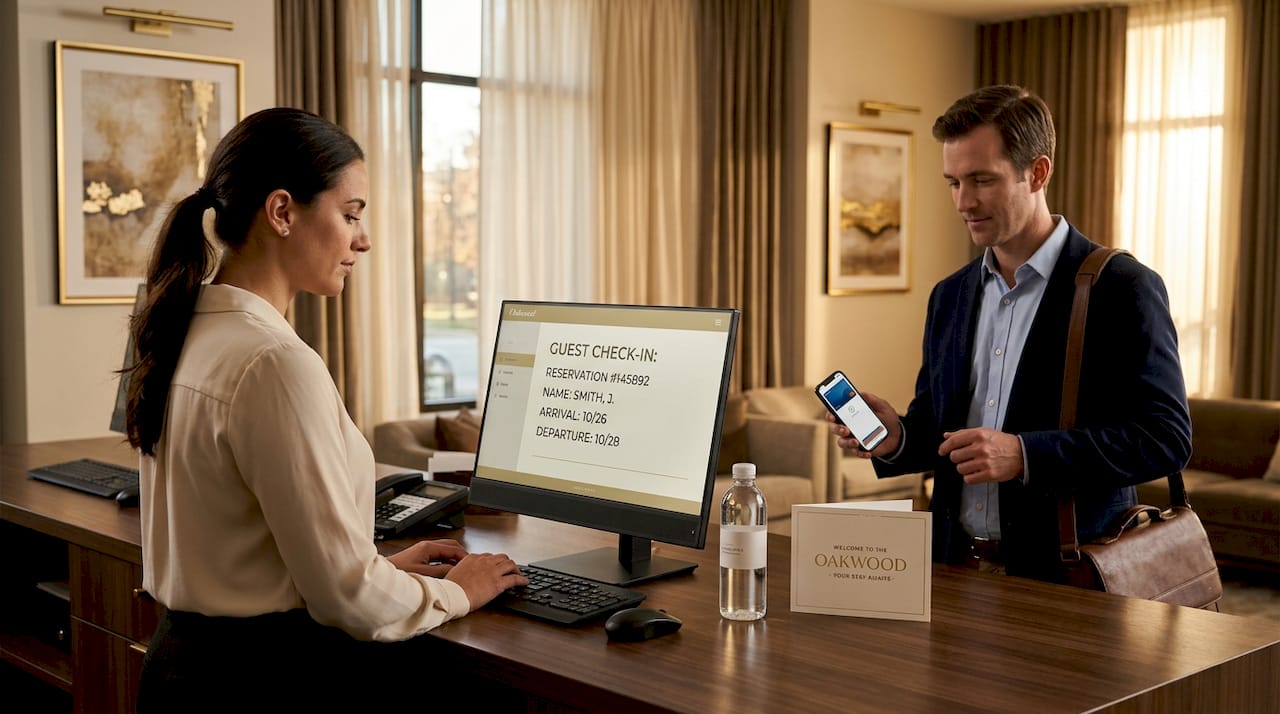
Physical key cards are going the way of fax machines. Mobile wallet keys, integrated directly with Apple Wallet and Google Wallet, are now deployed widely across major hotel brands, using encrypted communication that is actually more secure than a standard RFID card. Guests tap their phone to access their room, the fitness center, the parking garage, and any other controlled space.

The appeal goes beyond convenience. Digital keys collect intent signals. When a guest downloads their digital key four hours before check-in, that is a real-time signal that they will arrive early. Smart hotels use that signal to trigger a personalized message offering early check-in availability, a lunch reservation, or a spa booking. The technology connecting guest intent data to operational workflows turns a convenience feature into a revenue and satisfaction driver.
The broader landscape of guest experience technology in 2026 includes several interconnected developments:
Contactless check-in kiosks that verify identity via facial recognition and link directly to mobile wallet profiles, eliminating front desk queues entirely
In-room voice assistants configured to the property’s specific catalog of services, capable of placing orders, adjusting temperature, or requesting housekeeping without a phone call
Integrated guest messaging platforms that pull together pre-arrival, in-stay, and post-stay communication into a single thread personalized to each guest’s profile
Digital dining experiences that let guests browse restaurant menus from their room before heading downstairs, reducing wait times and increasing average spend per visit
Each of these tools works better when connected. A guest who checked in via mobile key, ordered room service through an in-room tablet, and rated their meal through a feedback prompt is building a profile that makes every future stay more personalized. That is the compounding value of integrated guest experience technology.
Governing agentic AI before it governs you
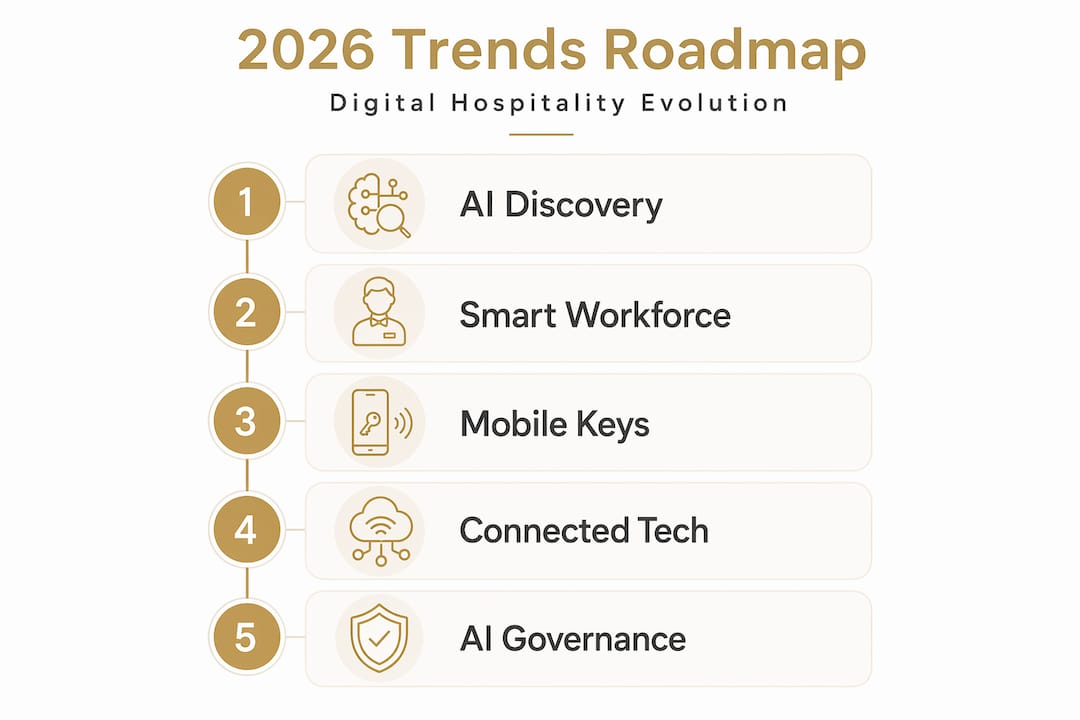
Agentic AI agents (systems capable of taking multi-step actions autonomously, like rebooking a guest, updating a reservation, or processing a refund) are moving from concept to deployment in hospitality operations. The speed is exhilarating. The governance picture is less so.
Only 21% of enterprises have mature governance models for agentic AI in place, even as they scale these systems across customer-facing functions. That means 80% lack key capabilities like real-time monitoring, audit trails, and escalation protocols. In hospitality, the consequences of a poorly governed AI agent are concrete: a guest’s reservation deleted in error, a pricing anomaly that charges the wrong rate, or a loyalty redemption processed incorrectly.
“Governance maturity is the bottleneck preventing agentic AI from scaling safely. Deliberate, cross-functional oversight is what separates organizations that capture AI value from those that absorb AI risk.”
The contrast between mature and immature governance approaches is significant:
Governance capability | Mature approach | Immature approach |
Monitoring | Real-time dashboards with anomaly alerts | Periodic manual reviews |
Audit trails | Every agent action logged and attributable | No record of automated decisions |
Escalation paths | Defined triggers that route to human staff | Agent operates until failure is noticed |
Cross-functional oversight | Legal, ops, and IT aligned on AI scope | Single team owns and deploys AI tools |
Guest data handling | Role-based access, encryption, consent management | Open system access for AI agents |
The solution is not to slow AI deployment. It is to build the governance infrastructure in parallel. Hotels and restaurants that deploy agentic AI with real-time monitoring and clear human oversight protocols will scale faster and safer than those that retrofit guardrails after something goes wrong.
My perspective: why 2026 demands full commitment, not more pilots
I’ve watched hospitality organizations spend three years testing AI tools with genuine enthusiasm and genuinely modest results. The reason is almost always the same. They treated AI as an addition to existing workflows rather than a reason to redesign them.
In my experience, the properties that capture real, lasting value from AI share one characteristic: they unified their data. Distribution data, operational data, and guest experience data are not separate systems feeding separate dashboards. They feed a single AI model that can see the whole picture, from a guest’s booking channel and room preference to their dining behavior and service feedback.
What I’ve learned from watching this play out is that the competitive gap in hospitality is not between properties that have AI and those that don’t. It is between properties whose AI systems talk to each other and those whose AI tools operate in isolation. The former sees compounding returns. The latter sees incremental improvements that rarely justify the investment.
My take on 2026 is direct: the window for testing AI piecemeal is closing. Decision-makers who invest now in unified, AI-native operating models will own the next decade of hospitality. Those still running pilots in 2027 will be managing the consequences of that delay.
— Abhi
How Mydigimenu helps you act on these trends today
The trends explored in this article share a common thread: digital experiences that reduce friction, capture data, and create personalized moments at scale. Mydigimenu was built precisely for that intersection.
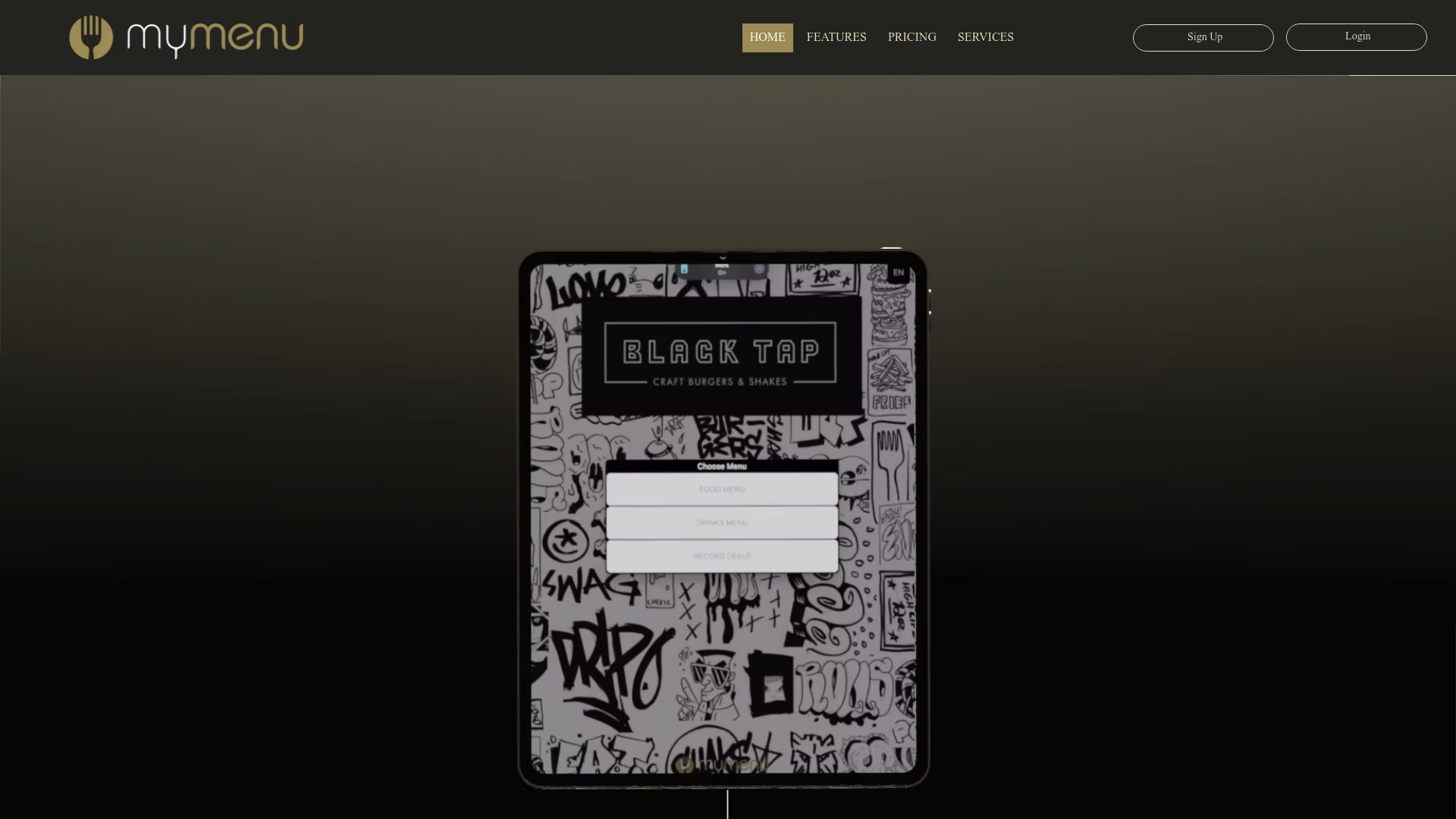
With Mydigimenu’s restaurant digital tablet menus and QR code menus, hotels and restaurants can deploy contactless ordering experiences that require no app download, support multiple languages and currencies, and integrate with existing POS systems. Every guest interaction becomes a data point that feeds smarter marketing, loyalty programs, and personalized upsells. Turning the mundane act of ordering into a memorable, data-rich experience is exactly what the future of hospitality demands. Explore plans and pricing to find the right fit for your property.
FAQ
What are the biggest digital hospitality trends in 2026?
The most significant shifts in 2026 are AI-driven booking discovery, mobile wallet digital keys, agentic AI in guest services, and integrated data platforms that connect distribution, operations, and guest experience into a single operating model.
How does AI change hotel booking and discovery?
AI assistants now aggregate content from multiple sources and surface only the most algorithmically relevant properties, replacing traditional keyword search. Hotels must publish structured, machine-readable content and build high-trust digital profiles to appear in those recommendations.
What is agentic AI and why does it matter for hospitality?
Agentic AI refers to systems that take multi-step autonomous actions, such as rebooking guests, processing refunds, or updating reservations, without human intervention at each step. It matters because it can dramatically reduce operational costs, but only 21% of enterprises currently have the governance structures to deploy it safely.
How are digital keys improving the guest experience?
Mobile wallet keys integrated with Apple Wallet and Google Wallet eliminate physical key cards, provide encrypted secure access, and generate real-time intent signals that hotels can use to trigger personalized offers and service workflows throughout a guest’s stay.
Why do most AI hospitality pilots fail to deliver returns?
Most fail because AI is added onto existing workflows rather than used to redesign them. AI-first operating models that unify distribution, commercial, and operational data consistently outperform properties that deploy AI as a standalone tool in a single department.
Recommended
Comments