
What is a restaurant CRM? Streamline guest loyalty and growth


TL;DR:
Effective restaurant CRMs focus on acting on insights, not just collecting guest data.
Key features include POS integration, automated segmentation, and personalized communication.
Success depends on consistent data hygiene, staff training, and phased implementation.
Most restaurant managers assume that collecting more guest data automatically leads to more loyal customers. It’s a seductive idea, but the numbers tell a different story. Research shows that restaurants using CRM strategically see up to a 19.5% increase in guest retention and 18.2% higher visit frequency, not because they gathered thousands of contacts, but because they acted on the right insights at the right moment. This guide breaks down what a restaurant CRM actually does, which features drive measurable results, and how you can turn guest data into genuine loyalty growth.
Table of Contents
Key Takeaways
Point | Details |
CRMs drive real results | Restaurant CRMs increase repeat visits, guest retention, and check size through data-driven engagement. |
Quality integrations matter | The most effective CRMs rely on strong POS and reservation system integration for maximum impact. |
Success requires process | Proper rollout, staff training, and data hygiene are essential for realizing CRM benefits. |
Look beyond contact lists | Track success through guest behavior and ROI metrics rather than just collecting more contacts. |
First-party data is the future | Owning your guest data and leveraging AI-driven insights will define the next wave of hospitality growth. |
What is a restaurant CRM?
Now that you see the impact restaurant CRMs deliver, let’s clarify what exactly a restaurant CRM is and what makes it unique compared to a generic business tool.
A restaurant CRM (Customer Relationship Management) system is a platform built specifically to centralize all guest interaction and sales data in a hospitality context. Unlike a generic CRM designed for sales pipelines or B2B contracts, a restaurant CRM is tailored to the rhythms of food service: table turns, repeat visits, menu preferences, and reservation patterns. It connects the dots between every touchpoint a guest has with your restaurant, from their first online order to their tenth in-house visit.
The core functions of a restaurant CRM include:
Guest preference tracking: Recording dietary needs, favorite dishes, seating preferences, and past orders to enable personalized service
Loyalty and marketing automation: Triggering reward offers, birthday messages, and re-engagement campaigns based on guest behavior
Order and reservation histories: Building a complete timeline of each guest’s relationship with your restaurant
Integration with POS and reservation systems: Syncing real-time transaction data so every record stays current and accurate
App-free loyalty solutions: Enabling guests to earn and redeem rewards without downloading anything
Digital reservation tools: Linking booking data directly into guest profiles for a seamless view
One of the most overlooked but critical aspects of a restaurant CRM is data hygiene. Duplicate records, misspelled names, and outdated contact details quietly erode the system’s effectiveness. As industry analysis confirms, best-practice methodologies involve deduplication, data standardization, and predictive scoring using RFM models (recency, frequency, and monetary value) combined with live engagement signals.
“A restaurant CRM is only as powerful as the data flowing into it. Clean, unified guest profiles are the foundation of every meaningful personalization and every campaign that actually converts.”
This distinction matters enormously. A generic CRM might track email opens. A restaurant CRM tracks whether a guest who loves your truffle pasta has visited in the last 30 days and whether they’re a churn risk worth targeting with a personalized offer tonight.
Core benefits of restaurant CRMs for managers
Understanding the functions is just the beginning. Here’s what adopting a CRM actually means for your restaurant’s bottom line and team.
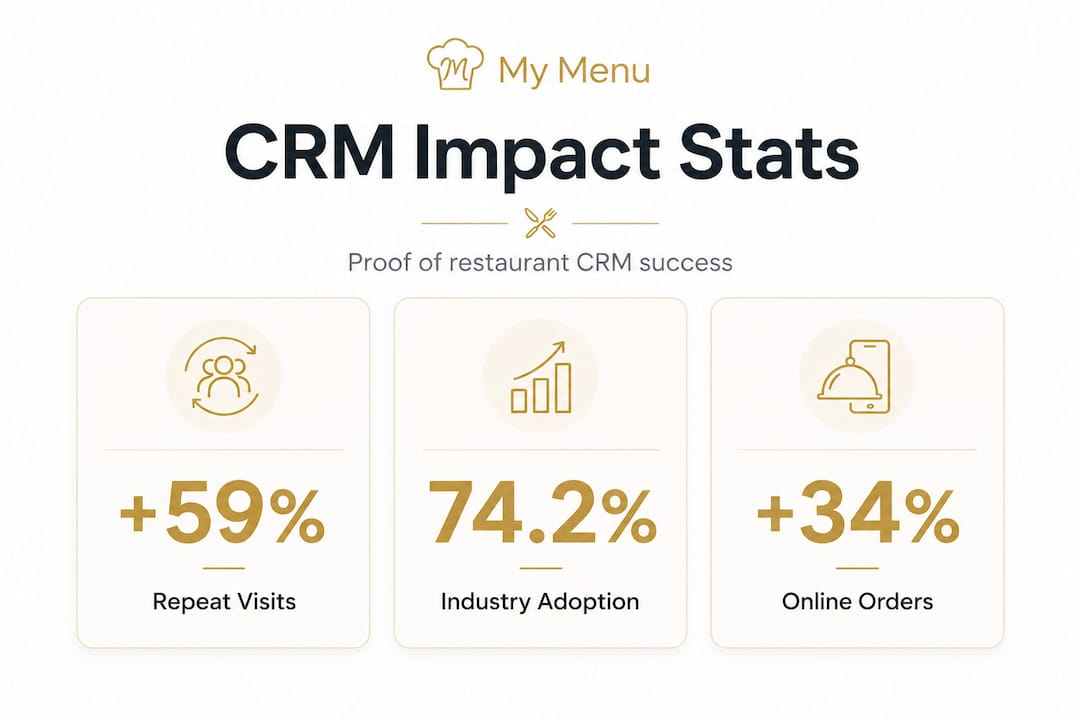
The data on CRM adoption in hospitality is striking. According to market research, 74.2% of restaurants in the US and Canada now use some form of CRM, and those restaurants report an average 20% improvement in customer retention alongside order values that run 15 to 25% higher than non-adopters. Those are not marginal gains. They are the kind of numbers that change a restaurant’s annual performance.
Two real-world case studies bring this to life. Restaurant Nora saw a 34% increase in online orders and a 59% jump in first-party channel share after deploying a CRM-integrated ordering strategy. Ocard, a loyalty platform used by restaurant groups across Asia, recorded a stunning 493% redemption boost after implementing automated, behavior-triggered loyalty campaigns.
Metric | CRM-enabled restaurants | Non-adopters |
Guest retention improvement | Up to 20% | Baseline |
Visit frequency increase | Up to 18.2% | Baseline |
Average order value increase | 15 to 25% | Baseline |
Online order growth (Nora) | +34% | N/A |
Loyalty redemption rate (Ocard) | +493% | N/A |
The features that consistently drive these outcomes are not complicated. They are simply well-executed.
Personalized communication: Emails and push messages that reference a guest’s actual history, not generic “we miss you” blasts
Automated reminders and win-back campaigns: Triggered messages for lapsed guests based on their typical visit cadence
Targeted reward offers: Loyalty perks tied to specific behaviors, like a free dessert after five visits rather than a blanket discount
Online ordering benefits that feed into CRM profiles: Every online order enriches guest records automatically
Loyalty strategy ideas that go beyond points: Experiential rewards, early access to new menus, and VIP recognition
Pro Tip: Stop measuring CRM success by how many contacts you’ve collected. Measure it by repeat visit rate and average check size. A database of 500 highly engaged regulars outperforms a list of 5,000 cold contacts every single time.
Must-have features and integrations for real-world results
To achieve the full benefits, you need to know which features matter most. Here’s where managers should focus their attention.
POS integration sits at the top of the priority list, and for good reason. Without a live connection to your point-of-sale system, your CRM is essentially working with yesterday’s news. Real-time data sync means that when a guest orders a specific wine pairing for the third time, your system flags it immediately. That is the kind of intelligence that powers relevant, timely outreach, not guesswork.
Equally important is automated guest segmentation. A capable restaurant CRM should automatically sort your guest database into meaningful groups: VIPs who visit weekly, occasional guests who come monthly, lapsed guests who haven’t returned in 90 days, and new guests who need a nurturing sequence to become regulars. This kind of dynamic segmentation removes the manual work and ensures every campaign reaches the right people.
Here is a feature checklist every manager should use when evaluating a restaurant CRM:
Feature | Operational impact |
POS integration | Real-time guest data; no manual entry |
Guest auto-segmentation | Targeted campaigns without manual sorting |
Automated email and SMS campaigns | Higher open rates; timely guest re-engagement |
Customizable loyalty workflows | Rewards tied to behavior, not just spending |
Reservation system integration | Full guest view from booking to bill |
Captures guest identity at the menu stage | |
First-party data capture | Reduces dependence on third-party platforms |
Analytics dashboard | Actionable insights, not just raw numbers |
Customizable loyalty workflows deserve special attention. The ability to trigger a specific reward after a specific guest action, such as a birthday offer, a post-visit survey reward, or a “welcome back” incentive for a lapsed guest, is what separates intelligent CRM use from a basic punch card. These workflows can run automatically once configured, meaning your team captures value around the clock with minimal ongoing effort.
Additional tools that amplify CRM effectiveness include seamless guest experience tips applied at the operational level, such as contactless menus that capture guest data through social login without friction.
As industry guidance confirms, success hinges on POS integration quality, staff training, and avoiding over-reliance on discounts as a retention tool. Measure ROI through repeat visits and average check improvement, not by the number of contacts stored.
Pro Tip: Invest in CRM staff training before launch, not after. When your front-of-house team understands why they’re capturing guest information and how it improves service, adoption rates climb dramatically and data quality improves with it.
Best practices for implementation and ongoing success
Even the best systems can fail if implemented poorly. Here is a proven path to CRM success for hospitality operations.
The most common mistake managers make is trying to do everything at once. A phased rollout is far more effective. Start with the automations that deliver the highest return: loyalty enrollment triggers, lapsed guest win-back campaigns, and birthday offers. These generate quick wins that build internal buy-in and demonstrate ROI before you expand into more complex workflows.
Step-by-step CRM rollout:
Audit your existing guest data and identify duplicates, missing fields, and outdated records before importing anything
Configure POS integration first, so every new transaction automatically enriches your guest database
Launch two or three high-value automations: a welcome series for new guests, a win-back sequence for lapsed ones, and a birthday reward
Train front-of-house staff on data capture protocols and explain the guest experience benefit, not just the operational task
Review key metrics monthly, specifically repeat visit rate, redemption rate, and average check, and adjust campaigns accordingly
Expand into advanced segmentation and predictive scoring once foundational workflows are proven
Data hygiene is not a one-time task. It is an ongoing discipline. The best-practice approach involves regular deduplication sweeps, field standardization (consistent name and email formats), and validation checks that flag records with missing or implausible data.
Data cleaning techniques that matter:
Merge duplicate records using email address as the primary identifier
Standardize phone number formats to prevent false duplicates
Remove or re-engage contacts that haven’t opened any communication in 12 months
Validate email addresses before any major campaign send
Audit reservation and POS sync accuracy quarterly
Understanding why digitalized restaurant operations improve data quality at the source makes this process much easier. When guest data flows in through digital touchpoints rather than handwritten forms, accuracy improves automatically.
“Don’t chase database growth. Chase engagement depth. A smaller, well-maintained guest database that actively responds to your campaigns is worth ten times a bloated list of cold contacts.”
Emerging trends: Predictive analytics, first-party data, and the future of restaurant CRM
Once your CRM is running smoothly, it is time to look ahead. Here is how data, AI, and first-party strategies will shape hospitality success in the coming years.
The single most important strategic shift happening in restaurant CRM right now is the push toward first-party data ownership. Third-party delivery platforms like major aggregators take a significant cut of revenue and, more critically, they keep the guest relationship for themselves. Restaurants that rely heavily on these channels are building loyalty for someone else’s platform, not their own.
Forward-thinking operators are prioritizing first-party data ownership precisely because third-party fragmentation is accelerating. Every guest who orders directly through your restaurant’s own digital channel is a guest whose data you own and whose relationship you can deepen over time.
AI-powered tools are also transforming how restaurants use their CRM data. Predictive analytics now make it possible to:
Forecast churn risk by identifying guests whose visit frequency is declining before they disappear entirely
Score guest lifetime value using RFM models to prioritize outreach toward your most profitable regulars
Personalize offers dynamically based on predicted next purchase, not just past behavior
Identify emerging VIPs among new guests who show early behavioral signals of becoming loyal regulars
Optimize campaign timing by predicting when individual guests are most likely to act on an offer
Next-generation CRM features worth watching include voice-activated order history retrieval for staff, real-time sentiment analysis from guest feedback integrated into guest profiles, and AI-generated personalized menu recommendations served through up-to-date loyalty strategies that adapt to seasonal preferences.
“The restaurants that will lead the next decade are not the ones with the most data. They are the ones who own their guest relationships and use predictive intelligence to act on them with precision.”
The shift is clear: move from reactive data collection toward proactive, intelligence-driven guest engagement. The tools are available now. The managers who act early will hold a meaningful competitive advantage.
Hard truths most restaurant managers miss about CRM success
It is easy to get caught up in the excitement of new technology. But here is what managers actually need to hear, based on real restaurant experience across the industry.
The uncomfortable truth is that most CRM underperformance is not a technology problem. It is a habit problem. A system configured beautifully but used inconsistently delivers almost nothing. The restaurants that see transformative CRM results share one trait: they treat guest data as a living operational asset, not a side project someone manages when time allows.
Another hard truth is about discounts. Many managers default to discount-heavy loyalty programs because they seem like an obvious lever for driving visits. But aggressive discounting trains guests to wait for deals rather than visit at full value. It erodes margin and, paradoxically, reduces the perceived value of your brand over time. The most effective loyalty programs reward visit frequency and engagement with experiences and recognition, not just price cuts.
The digital solutions that work for long-term guest retention are the ones built around genuine personalization, where a guest feels seen and valued, rather than the ones optimized purely for short-term transaction volume.
Contact quality beats contact quantity. One hundred guests who open your emails, redeem your offers, and return monthly are infinitely more valuable than five thousand contacts who ignore everything you send. Prioritize first-party data ownership, workflow discipline, and personalized engagement, and the results follow.
Pro Tip: Review your CRM’s unsubscribe and open rates quarterly. If open rates are below 20%, your segmentation or messaging needs work. If churn in your loyalty program exceeds 40% annually, your rewards are not compelling enough to sustain engagement without discounts.
Ready to elevate your restaurant’s guest experience?
The strategies in this article show what is possible when smart CRM use meets the right digital tools. Great guest relationships start before guests even sit down, and the technology to build them is more accessible than ever.
MyDigiMenu.com connects your CRM strategy to the front line of your guest experience. From digital menu solutions that capture guest profiles at the very first interaction to intuitive QR menus that feed first-party data directly into your system, the platform is designed to turn every visit into a loyalty-building moment. Explore how MyDigiMenu’s suite of contactless, data-rich tools can help you own your guest relationships, boost repeat visits, and make every dining experience feel personal and memorable.
Frequently asked questions
How does a restaurant CRM increase guest loyalty?
By recording guest interactions and preferences, CRMs enable personalized service and targeted rewards that keep guests coming back. Restaurants using CRM report up to a 20% improvement in customer retention and an 18.2% increase in visit frequency.
What integrations are most important for a restaurant CRM?
POS systems and reservation platforms are the most critical integrations, as they ensure real-time data sync and accurate, complete guest profiles without manual data entry.
How can restaurant managers measure CRM ROI effectively?
Track repeat visit rates and average check size rather than database size, since ROI measurement through engagement metrics reveals true CRM impact far more accurately than contact counts.
Is AI or predictive analytics necessary for small restaurants?
Not essential right now, but AI-powered CRM tools for churn forecasting and VIP identification are increasingly affordable and accessible, making them worth exploring even for smaller independent operations.
Recommended
Comments