
Hospitality Loyalty Program Workflow: A Manager's Guide


TL;DR:
A QR-first, event-triggered loyalty program captures guest profiles at the table, automates personalized reengagement, and offers frictionless redemption. Implementing simple earn rules and automation triggers significantly boost guest rebooking and lifetime value. Staff training and compliance integration are essential for scalable, effective loyalty workflows in hospitality venues.
A QR-first, event-triggered hospitality loyalty program workflow captures guest profiles at the table, awards points from POS and PMS transaction events, automates personalized reengagement, and makes redemption frictionless at checkout. Returning guests spend significantly more per stay than first-timers, which makes a well-run loyalty workflow one of the highest-return operational investments a venue can make. The core sequence: QR enrollment → unique CRM profile → earn on POS/PMS events → automated triggers (post-stay, birthday, win-back) → frictionless redemption. Your immediate next step: run a 30-day pilot capturing enrollments via table QR codes and post-stay email triggers, then measure enrollment rate and rebooking lift.
Key compliance hooks to wire in from day one:
CAN-SPAM for all marketing emails (clear sender, opt-out link, physical address)
TCPA opt-in consent before any SMS or automated calls
PCI DSS scope management for any card data touching your loyalty flow
Mydigimenu is the platform referenced throughout this guide as the practical implementation example.
Table of Contents
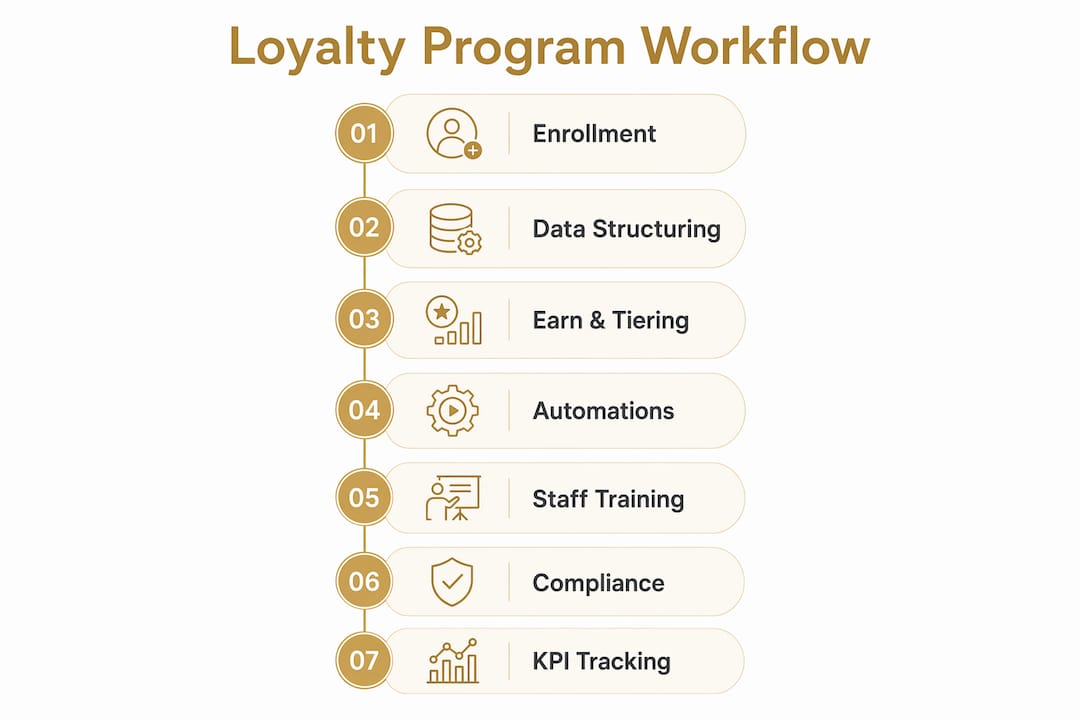
What does a step-by-step loyalty workflow look like?
A repeatable hotel loyalty program process moves through six ordered stages, each with a clear owner and a pilot metric to validate it before you scale.
Enroll — Guest scans a QR code, taps a POS prompt, or clicks a post-stay email link. Capture name plus email or phone OTP. Pilot metric: enrollment rate as a percentage of covers or check-ins.
Profile creation and ID mapping — System generates a unique guest ID and links it to the POS check, folio, or reservation number. Pilot metric: profile completion rate.
Earn events and tagging — POS item codes or folio IDs fire a webhook that credits points or tier status automatically. Pilot metric: award accuracy rate (points credited vs. eligible transactions).
Redemption rules — Guest redeems via voucher code at POS or online cart. Staff validate identity and apply the discount. Pilot metric: redemption accuracy.
Automation triggers — Post-stay email within 48 hours, birthday offer, and win-back after 12 months of inactivity fire from the CRM without manual effort. Pilot metric: open and click rates per trigger.
Measurement and iteration — Review enrollment, redemption, and repeat-booking rates monthly. Adjust earn ratios or trigger timing based on data.
Which enrollment channels actually convert guests?
No-app, QR-first systems let guests join, track points, and redeem in a mobile browser, lifting participation compared with standalone app models. The highest-converting channels, in order:
Table QR codes — placed on tent cards, menus, or receipt folders; guests scan mid-meal when engagement is high
POS prompt at payment — server or host asks at checkout; captures guests who missed the table QR
Post-stay email join link — reaches guests who were too busy during the visit
Social login — optional one-tap profile creation using an existing Google or Apple account, reducing form friction
For first-touch capture, collect only name plus email or phone OTP, then enrich the profile over time with dining preferences and visit history. Offline fallback: a paper enrollment card or a staff-assisted phone entry into the CRM, reconciled at end of shift.
Pro Tip: Keep your enrollment CTA to ten words or fewer. “Join free, save 10% on your next visit” outperforms a paragraph of program details every time.
How should you structure your CRM data model?
The guest profile is the loyalty program’s engine. Every earn and redemption event must resolve to a unique guest ID, or reconciliation becomes a manual nightmare.
Field | Purpose |
Unique guest ID | Primary key linking POS, PMS, and CRM records |
Email / phone | Contact and consent verification |
Consent flags | CAN-SPAM email opt-in, TCPA SMS opt-in, date stamped |
Source channel | QR, POS, web, social login |
Tier / status | Current loyalty level and qualifying criteria |
Lifetime value | Total verified spend across all visits |
Stay / visit history | Folio IDs and reservation IDs linked to profile |
Preferences | Dietary, room type, favorite menu items |
Map POS item codes, folio IDs, or reservation IDs to loyalty events at the source system and fire webhooks for each loyalty-relevant transaction. This eliminates manual reconciliation and keeps the profile accurate in real time.
How do you design earn rules and tiering that staff can explain?
Simple rules win. Operators who fund member rates from OTA commission savings and promote them in post-stay emails report stronger adoption than those running complex multi-category point schemes.
Flat points per dollar: 1 point per $1 spent; 500 points = $25 voucher. Easy for guests to calculate, easy for staff to explain.
Visit-based digital stamp card: 10 visits = one complimentary item. Works especially well for cafes and bars.
Member-only direct booking rate: 10–15% below best available rate, funded from the OTA commission you save. Often more motivating than abstract points.
On tiering: single-level member recognition suits most independent venues. Add a second tier (e.g., Silver/Gold) only when you have enough repeat guests to make the aspiration credible. For detailed mechanics on points and vouchers, the structure matters less than clarity.
How does redemption work at POS and online?
Frictionless redemption is where most programs fail. Design two clean paths and train staff on both.
In-POS redemption — Guest provides name or phone number; staff look up the profile, confirm the balance, and apply the voucher code or discount before payment is processed.
Online redemption — Guest enters a voucher code at the booking cart or the code auto-applies when the member logs in. Confirm the deduction by email immediately.
Reward design choice — Small, immediate rewards (a free coffee at 5 stamps) drive frequency; larger milestone rewards ($50 voucher at 500 points) drive spend. Run both if your POS supports it.
Expiry and liability — Set a clear expiry (12 months is standard) and communicate it in the reward confirmation email. Cap outstanding liability by limiting monthly issuance if needed.
Offline contingency — When systems are down, staff validate a printed or screenshot voucher against a paper log, then reconcile in the CRM at end of shift.
What event-triggered automations deliver the best retention ROI?
Event-triggered lifecycle automation outperforms generic date-based newsletters because the message arrives when the guest is already thinking about you. Design automation rules around guest actions, not calendar dates.
Core trigger flows:
Post-stay (within 48 hours): Thank-you message + review request + member-only direct booking offer. A 48-hour post-stay sequence combining WhatsApp and email channels drives higher open and conversion rates than generic campaigns.
Birthday recognition: Member-only dining voucher or room upgrade offer sent 7 days before the birthday.
Win-back (12 months inactive): “We miss you” message with a time-limited incentive, personalized to last visit type.
Segmentation using RFM (Recency, Frequency, Monetary):
Score each guest on recency of last visit, visit frequency, and total spend.
High-RFM guests get VIP upgrade offers and early access to new menu items.
Mid-RFM guests receive frequency nudges (“You’re 2 visits from Silver”).
Low-RFM guests enter the win-back sequence automatically.
For deeper customer engagement flows and post-stay messaging, the timing and personalization of each trigger matter as much as the offer itself.
How do you train staff and run a successful operational rollout?
Front-of-house training determines whether a technically sound program actually enrolls guests. A loyalty program layered on top of poor guest engagement has limited impact regardless of its mechanics.
Role-specific training sessions (60–90 minutes): Hosts and servers learn the enrollment pitch; payment staff learn redemption validation; managers learn the dashboard and escalation path.
10-second enrollment script: “Scan this code to join our rewards program — you’ll save 10% on your next visit and we’ll remember your favorites.”
Redemption validation script: “Can I get your name or phone number? I’ll pull up your balance and apply it before we run the card.”
Dispute handling: Staff should be able to manually credit points for a missed transaction using a manager override, with a paper trail logged in the CRM.
Operational KPIs to track weekly: enrollment rate, profile activation rate, redemption accuracy, and a staff adoption score (percentage of eligible transactions where enrollment was offered).
Pro Tip: Post a laminated quick-reference card at each POS station with the enrollment script, redemption steps, and the manager’s phone number for disputes. Adoption doubles when the answer is always within arm’s reach.

For a full digital loyalty program guide covering staff adoption and simple program mechanics, the operational layer is where most venues win or lose.
What integrations and U.S. compliance steps do you need?
The hotel check-in workflow is a natural enrollment touchpoint, but only if your systems talk to each other.
Integration checklist:
Guest ID sync between PMS and CRM (bidirectional)
POS item codes and folio IDs mapped to loyalty event types
Voucher API endpoints for online redemption
Webhooks firing on checkout, high-spend threshold, and referral events
Fallback CSV import for properties without real-time API access
U.S. compliance checkpoints:
CAN-SPAM: Every marketing email needs a clear sender name, physical address, and a working unsubscribe link honored within 10 business days.
TCPA: Obtain explicit written opt-in before sending any SMS or using an auto-dialer. Document the consent timestamp and source.
PCI DSS: Keep card data out of your loyalty database entirely. Tokenize at the POS and pass only the token to the loyalty system.
Run sandbox event tests before go-live, execute a reconciliation run against 30 days of historical transactions, and document a rollback plan for integration failures.
What KPIs should you track on your loyalty dashboard?
Properties with active retention programs can move from roughly 11% return rate to roughly 34% with post-stay sequences and member-rate offers. Track the metrics that predict that trajectory.
KPI | Pilot Target (first 90 days) | Steady-State Target |
Enrollment rate | 10–20% of covers / check-ins | 25%+ |
Member activation rate | 60% complete profile | 75%+ |
Redemption rate | 15% of eligible members | 20%+ |
Repeat-booking rate | Baseline + 5 pts | 25–35% from members |
Member LTV vs. non-member | Track gap | Members 20%+ higher |
Add cohort retention, RFM segment performance, cost-per-reward, and ROI per campaign to your monthly review once the pilot stabilizes.
What does a pilot-to-rollout checklist look like?
Phase | Timeline | Key Milestones |
Setup | Weeks 1–2 | QR placement, POS mapping, CRM profile fields, consent forms |
Staff training | Week 3 | Role-specific sessions, scripts posted at POS |
Soft launch | Weeks 4–6 | Enrollment live, post-stay automation active, dashboard baseline |
Pilot review | Week 8 | Enrollment rate, redemption accuracy, automation open rates |
Full rollout | Weeks 9–12 | All locations synced, tiering active, RFM segments live |
Cost buckets to budget:
Platform subscription (varies by tier; check USD pricing for current plans)
POS integration time (typically 4–8 hours of developer or vendor time)
Staff training hours (allow 2–3 hours per role across all shifts)
Reward funding budget (member-rate discounts funded from OTA commission savings)
Contingency for manual reconciliation during the first 30 days
How do you handle loyalty program disputes and errors?
Disputes fall into three categories: missing points, incorrect redemptions, and expired reward complaints. Each needs a documented resolution path.
For missing points, the fastest fix is a manager-override credit backed by a POS receipt or folio number. Log the adjustment in the CRM with a timestamp and reason code so patterns surface in your monthly review. Incorrect redemptions (a discount applied to the wrong check) require a reversal entry in the POS and a corrected loyalty record. Train one manager per shift to handle both without escalating to IT.
Expired reward complaints are mostly a communication failure. If a guest missed the expiry, a goodwill credit of half the expired value costs little and converts a frustrated guest into a vocal advocate. Document your goodwill policy in writing so staff apply it consistently.
How do you build a loyalty architecture that scales?
Start with a single guest ID as the canonical key across every system. Every POS, PMS, booking engine, and marketing tool resolves to that ID, which means adding a new property or channel is an ID-mapping exercise, not a rebuild.
Use event-driven webhooks rather than nightly batch imports. Webhooks fire the moment a transaction closes, keeping balances accurate and enabling real-time redemption at the POS. As you add locations, each property fires events to the same central CRM, and the dashboard aggregates by property, region, or brand. For guest experience practices that support loyalty adoption at scale, the architecture should feel invisible to the guest and manageable for the operator.
Key Takeaways
A well-executed hospitality loyalty program workflow requires QR-first enrollment, event-triggered automation, and front-line staff training to convert first-time guests into loyal regulars.
Point | Details |
QR-first enrollment wins | No-app QR codes at tables and receipts remove the biggest barrier to guest sign-up. |
Event triggers beat newsletters | Post-stay, birthday, and win-back automations drive higher conversion than generic campaigns. |
Simple rewards outperform complex ones | A flat 1 point per $1 or a member-only direct booking rate of 10–15% below the best available rate is easier for staff to explain and guests to value. |
Compliance is non-negotiable | CAN-SPAM, TCPA, and PCI obligations must be built into the workflow from day one, not added later. |
Mydigimenu supports the full workflow | QR enrollment, guest profiles, POS integrations, digital vouchers, and automation are all available on the platform. |
Why operations beat features every time
The most common loyalty program mistake is spending weeks configuring point multipliers and tier logic before a single staff member knows how to pitch enrollment. Programs that prioritize front-of-house training and simple mechanics consistently outperform technically sophisticated systems that nobody on the floor can explain.
The 10-second enrollment script and the laminated POS card matter more than a fifth loyalty tier. A guest who enrolls because a server asked confidently is worth infinitely more than a guest who abandoned a six-field signup form. Start with a 30-day QR pilot, measure enrollments and rebookings, and let the data tell you what to build next. Complexity earns its place only after simplicity has proven the model.
Mydigimenu brings this workflow to life for your venue
Mydigimenu is built for exactly this kind of operator-first loyalty deployment. Guests join through a QR menu scan with no app download required, and their profile is created instantly with social login or OTP. The platform captures guest data, links it to POS and PMS events, and fires event-triggered automations for post-stay, birthday, and win-back sequences without manual effort.
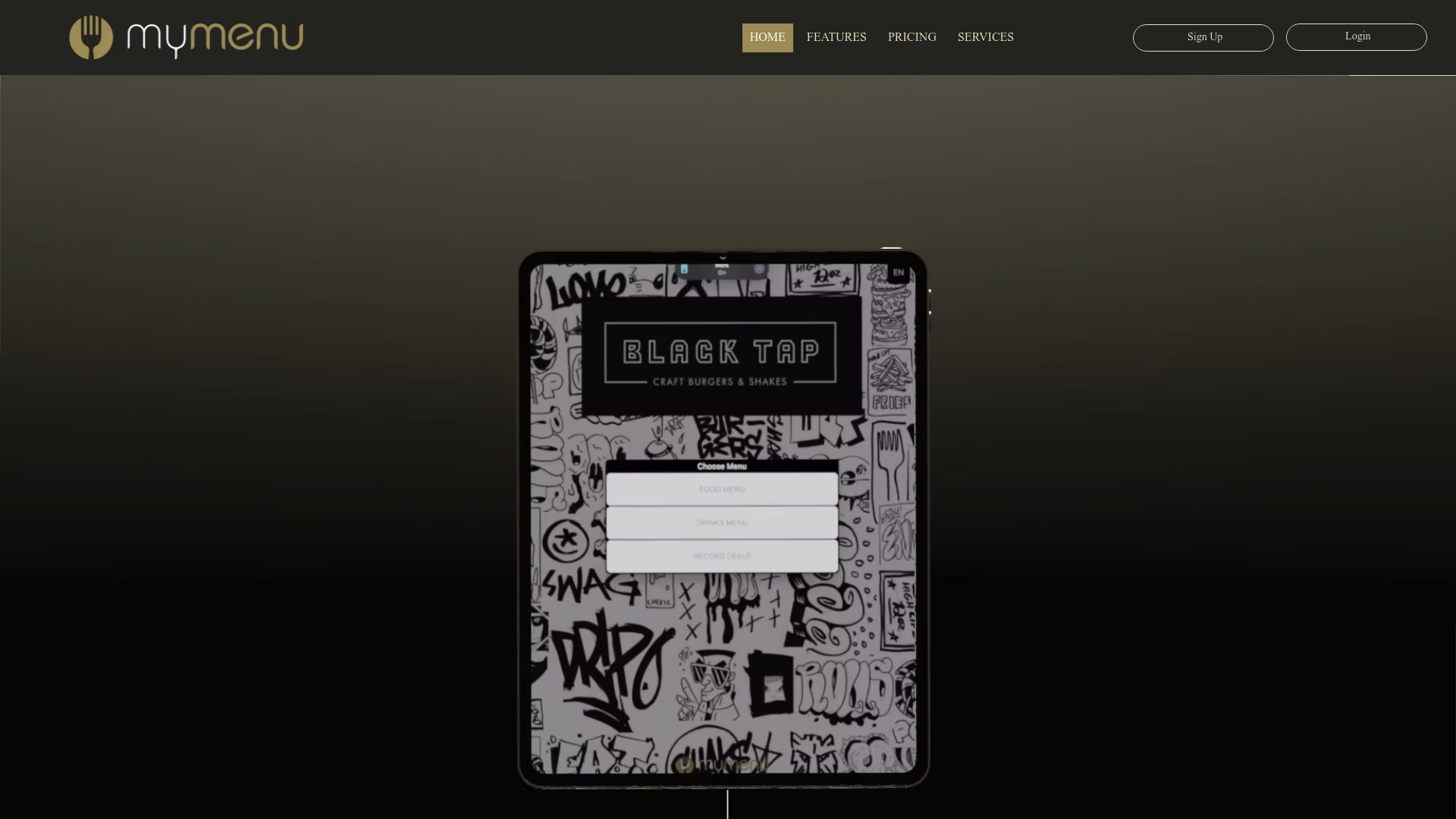
Digital stamp cards and vouchers are native to the platform, and the reporting dashboard tracks enrollment, redemption, and repeat-booking rates in one place. Front-desk setup is manageable without a developer, and the guest-facing experience is fully white-labeled to your brand. Whether you run a single café or a multi-property hotel group, Mydigimenu scales with you. Check current USD plans and book a demo to start your 30-day pilot today.
Useful sources
8 Effective Customer Retention Strategies for Hotels — RFM segmentation, VIP personalization, and CRM-driven outreach tactics
10 Customer Retention Strategies for STR Managers — Event-triggered automation and member-rate funding from OTA commissions
Hospitality Experience Marketing — 48-hour post-stay sequences, member-rate benchmarks, and return-rate case evidence
Loyalty Program: Complete Guide for Hospitality and Luxury Brands — QR/no-app enrollment, front-of-house training, and operational adoption
Hotel Guest Engagement and Retention — Pre-arrival and in-stay engagement as the foundation for loyalty success
Oracle Hospitality OPERA Cloud Loyalty Documentation — Technical reference for tier management, point calculation rules, and PMS integration
Hotel Check-In Process Workflow — Aligning check-in touchpoints with loyalty enrollment capture
This article is general operational guidance, not legal or compliance advice. Confirm current CAN-SPAM, TCPA, and PCI DSS requirements with a qualified compliance professional for your specific situation.
Recommended
Comments